Blog

  • The “Instant Regret” Angle: She Made Him Cry Over $5, Then Instantly Regretted It When HE Stepped In

    The “Instant Regret” Angle: She Made Him Cry Over $5, Then Instantly Regretted It When HE Stepped In

    The cashier screamed at the crying boy to empty his pockets, convinced he was a thief, but she never expected the terrifying biker behind him to say the one thing that would cost her everything.

    The fluorescent lights of the “Stop & Shop” hummed with a headache-inducing buzz, a sound ten-year-old Leo usually ignored. But today, it sounded like a siren. His hands, small and trembling, clutched a crumpled five-dollar bill—birthday money from his grandmother. He had walked three blocks, his heart light, dreaming of the sour gummy worms he had been promised all week. He didn’t know that in less than five minutes, that dream would turn into a nightmare that would freeze his blood.

    Leo walked down the aisle, the colorful wrappers of candy bars gleaming under the lights. He was careful. His mom always told him, “Hands where they can see them, Leo. Don’t touch unless you buy. Don’t run.” He followed the rules. He always followed the rules. He picked up the small bag of gummies, holding it delicately between two fingers like it was made of glass, ensuring anyone watching could see he wasn’t hiding anything.

    But someone was watching. And she wasn’t seeing a boy with birthday money. She was seeing a target.

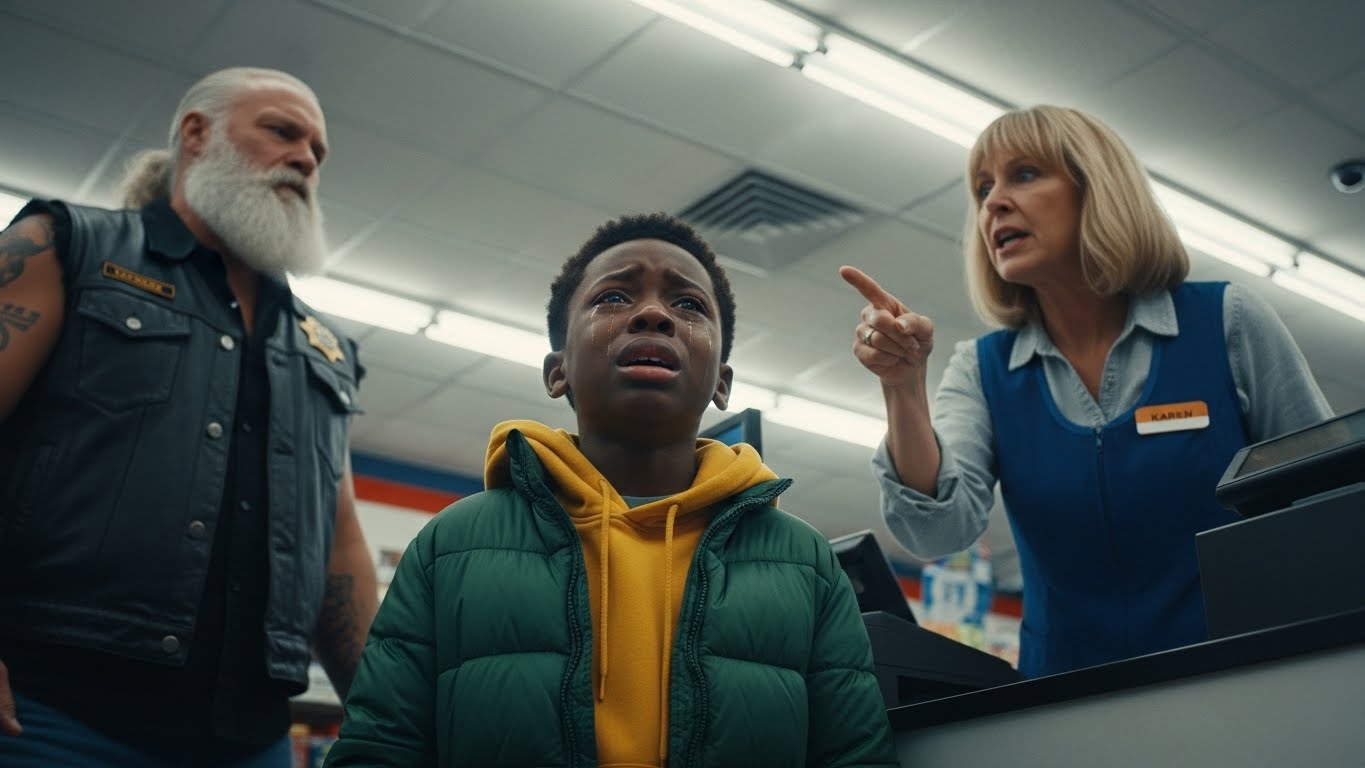
    Brenda, the shift manager, stood behind the counter. She had been having a bad week, a bad month, maybe a bad life. The “Karen” nametag pinned to her maroon apron felt less like a name and more like a prophecy she was determined to fulfill. She narrowed her eyes as Leo approached the counter. She didn’t see the innocence in his wide eyes; she saw a hoodie, a puffer jacket, and an opportunity to exert the little power she had.

    Part 2: The Accusation

    Leo placed the candy on the counter and reached for his pocket to get the money. “Don’t,” Brenda barked, her voice slicing through the air like a whip. Leo froze. His hand hovered over his pocket. “M-ma’am?” “I saw you,” she lied, her voice dripping with venom. “I saw you put something else in that pocket. Empty it. Now.”

    Leo’s breath hitched. “I didn’t… I just have my money.” “Don’t lie to me, kid. I know your type,” she sneered, leaning over the counter, invading his space. “You pocket that candy? You pay for it or you walk out. Actually, just walk out. I’m calling the police.”

    The word Police hit Leo like a physical blow. Tears, hot and stinging, welled up instantly. He wasn’t a thief. He was just a kid. But looking at Brenda’s twisted, angry face, he realized the truth didn’t matter to her. She wanted him to be guilty. The air in the store felt thin, suffocating. Leo looked around, desperate for help, but the store seemed empty. He was small, alone, and terrifyingly voiceless against an adult who had already decided his fate. The tears spilled over, tracking silently down his cheeks. He tried to speak, to say I have five dollars, but his throat closed up.

    Part 3: The Rumble Outside

    Outside, the distinct, thunderous roar of a Harley Davidson engine cut off, followed by the heavy thud of boots hitting the pavement. The bell above the door jingled—a cheerful sound that clashed with the toxicity in the room.

    In walked a giant. He had to be six-foot-four, wearing a leather vest covered in patches: “Vietnam Vet,” “Road Captain,” skulls, and flames. His arms were covered in ink, his head was shaved, and a long, white beard flowed down his chest like a wizard’s, but much scarier. He looked like the kind of man people crossed the street to avoid. He looked like trouble.

    Brenda’s eyes flickered to the biker, and a smug smirk touched her lips. She assumed this rugged, scary-looking man would be on her side. A “law and order” type. “Perfect timing,” Brenda said, gesturing at sobbing Leo. “I’m just handling a little shoplifter here. These kids think they can take whatever they want.”

    Leo flinched, shrinking into his coat. He waited for the big man to yell at him too. He waited for the rough hand on his shoulder.

    Part 4: The Intervention

    The biker, whose road name was “Silas,” didn’t look at Brenda. He looked down at Leo. He saw the trembling hands. He saw the crumpled five-dollar bill peaking out of the boy’s grip. And he saw the terror—a terror no child should ever feel in a candy aisle.

    Silas walked up to the counter. The floorboards creaked under his weight. He smelled of gasoline, leather, and old tobacco. He stopped directly between Leo and Brenda, using his massive back to shield the boy from her glare.

    “He stealing?” Silas asked, his voice a low rumble, like distant thunder. “He’s trying to,” Brenda said, crossing her arms. “I told him to empty his pockets.”

    Silas turned slowly to look at Leo. He knelt down on one knee—a movement that made his leather vest creak loudly. He was now eye-level with the terrified boy. “Hey, little man,” Silas said. His voice was surprisingly soft, contrasting with his terrifying appearance. “You got money for that?” Leo nodded frantically, opening his hand to show the five-dollar bill. Silas nodded. He stood up to his full height and turned to Brenda. His eyes, which had been soft a moment ago, were now cold as steel.

    “He’s got money,” Silas said. “He’s crying because you’re bullying him. Not because he’s guilty.” “You don’t know what you’re talking about!” Brenda snapped, though her voice wavered slightly. “I’m the manager here!”

    Part 5: The Lesson

    Silas reached into his own pocket. He pulled out a crisp hundred-dollar bill and slammed it on the counter. The sound echoed like a gunshot. “Ring it up,” Silas commanded. “What?” Brenda blinked. “The candy. Ring it up. And ring up whatever else he wants. Actually…” Silas looked around the store. “Ring up everyone’s stuff in the store. I’m paying for everything. Except you.”

    Brenda stood stunned. “You can’t do that.” “I just did,” Silas growled. “Now take the money, give the kid his receipt, and apologize.” “I will not—” “Apologize,” Silas roared. The volume didn’t go up much, but the intensity doubled. It was the voice of a man who had seen things Brenda couldn’t imagine, a man who had no patience for bullies.

    Brenda, shrinking under the gaze of the biker and the other customers who had now gathered and were filming on their phones, mumbled a pathetic, “Sorry.”

    Part 6: The Aftermath

    Silas handed the bag of gummy worms to Leo. He leaned down again. “Listen to me, son,” Silas said, ignoring Brenda completely. “There are people in this world who are small inside. They try to make themselves feel big by making you feel small. You got that?” Leo wiped his eyes and nodded. “You stood your ground. You stayed honest. That makes you the biggest man in this room. You remember that.”

    Silas walked Leo to the door. “Go home to your mama, kid. Stay safe.”

    As Leo ran out, clutching his candy like a trophy of survival, Silas turned back to Brenda one last time. “I ride with a group of forty guys,” he said calmly. “We stop here for gas every Tuesday. But I don’t think we’ll be stopping here anymore. And once that video hits the internet…” He pointed to a teenager filming in the corner. “…I don’t think anyone else will either.”

    Brenda was fired two days later after the corporate office saw the footage. Leo never went back to that store, but he never forgot the day a monster tried to break him, and a “monster” saved him.

  • He Fired Six Maids Because of His Daughter — Until the Seventh Did Something No One Expected…

    He Fired Six Maids Because of His Daughter — Until the Seventh Did Something No One Expected…

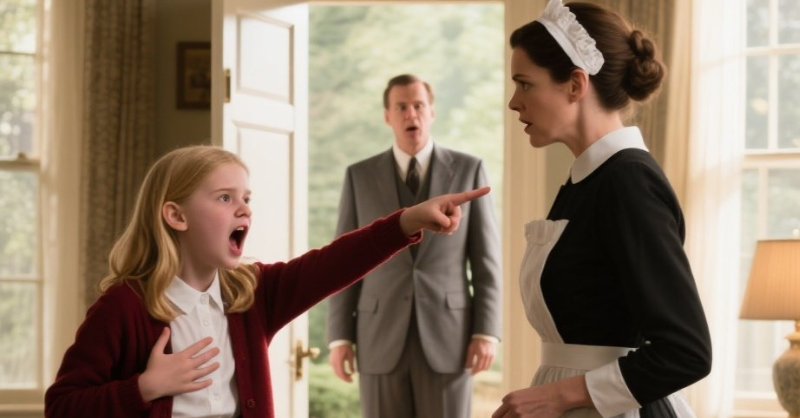
    James Callahan froze in the marble foyer of his home in Hartford, his briefcase still in hand. The voice was his ten-year-old daughter, Emma — sharp and shaking with anger. For months, peace had been a stranger here.

    A widower for five years, James had buried himself in work. His business was thriving, but his home had become hollow. Since her mother’s death, Emma had turned defiant, cruel at times. Six housekeepers had quit, all in tears.

    That morning, a new housekeeper had arrived — a quiet woman named Rosa Delgado, mid-forties, with kind eyes and a calm smile. “Children just need patience,” she’d said softly. “I’ve raised three of my own.”

    James had wanted to believe her.

    Now, hearing the crash of something breaking upstairs, he rushed up the steps two at a time. The shouting stopped. Only silence.

    At the top of the stairs, he found Emma’s door cracked open. Inside, Rosa stood beside the bed, calm but firm. On the floor lay a shattered vase, water spreading across the carpet.

    “What’s happening here?” James demanded.

    Neither spoke at first. Emma’s eyes darted between them before she shouted, “She hit me!”

    James’s heart sank. He turned to Rosa. “Is that true?”

    Rosa shook her head gently. “No, sir. But she said something no child should ever say.”

    James frowned. “What did she say?”

    Rosa hesitated. “It’s better if you ask her.”

    Emma’s chin quivered. Her eyes filled with tears, but she didn’t look away.

    James knelt beside her. “Emma,” he said quietly, “tell me the truth.”

    Her voice broke. “I told her she’s just like Mom. That she’ll leave too. Everyone leaves.”

    Rosa’s expression softened, and understanding struck James like a wave. Emma wasn’t cruel — she was grieving.

    He remembered the night his wife, Laura, died. Emma had been five, clutching her teddy bear beside her mother’s hospital bed.

    Since then, laughter had disappeared from their home, replaced by silence and work. He’d mistaken her fear for defiance.

    “I don’t hate her,” Emma whispered. “I just don’t want her to go away like Mom did.”

    Rosa knelt down beside her, gently placing a hand on her shoulder. “Sweetheart, I’m not going anywhere. I promise.”

    That night, the house felt different. Rosa served homemade soup and warm bread — the kind Laura used to make. For the first time in years, James and Emma ate together without tension.

    Over the following weeks, Rosa brought small changes — soft humming while she cleaned, fresh flowers on the table, lavender tucked into Emma’s drawers. Slowly, laughter began to return.

    A month passed. Emma stopped yelling. James started coming home early. He often found them curled up together on the couch, reading.

    But not everyone was happy. When James’s sister, Margaret, visited, she pulled him aside. “You’re getting too close to that woman,” she warned. “She’s just help. Don’t forget her place.”

    James’s reply was quiet but firm. “Her place is right where she is — helping my daughter smile again.”

    One rainy evening, Rosa didn’t return from the store. Emma waited by the window, worried. Then the phone rang.

    “There’s been an accident,” said a nurse.

    James raced to the hospital. Rosa was conscious, her arm in a sling. “A driver ran a red light,” the nurse explained.

    Rosa gave a weak smile. “I’m sorry about dinner, sir. I didn’t mean to frighten Emma.”

    “Don’t apologize,” James said softly. “You’ve given us more than you know.”

    When she came home, Emma ran into her arms. “Don’t ever leave again!”

    Rosa hugged her tightly. “Never, sweetheart.”

    As she recovered, Rosa shared her past. Years ago, she’d been a nurse. But after losing her husband and son in a house fire, she couldn’t face the world of hospitals again. She’d taken quiet jobs to survive, carrying her grief in silence.

    When she arrived at the Callahan home, she recognized the same pain — a father lost in work, a child afraid to love again.

    “You didn’t just help Emma,” James told her one evening. “You helped me remember what home feels like.”

    Months later, Rosa left her position — not because she was dismissed, but because James asked her to stay as family.

    The woman who came as a housekeeper became something far more — the heart that brought warmth back to a house that had forgotten how to love.