A billionaire heard his dead wife’s song from a homeless girl on a Seattle street… Then he saw her eyes and his world shattered.
The rain hammered Seattle’s downtown like it had a grudge. I sat in the back of my Maybach, stuck in gridlock on 4th Avenue, moving numbers on a screen that meant nothing. Julian Thorne. Tech billionaire. Empty mansion. Dead wife. Ten years since Elena died. Ten years of breathing without living. “Traffic’s locked, Mr. Thorne,” Marcus said from the driver’s seat. “Accident ahead. Twenty minutes, maybe more.”
I lowered the window an inch. Needed air that didn’t taste like leather and regret. That’s when I heard it. “Sleep now, the stars are fadingโฆ the moon has lost its glowโฆ” My finger froze over the tablet screen. My heart actually stopped. That song.
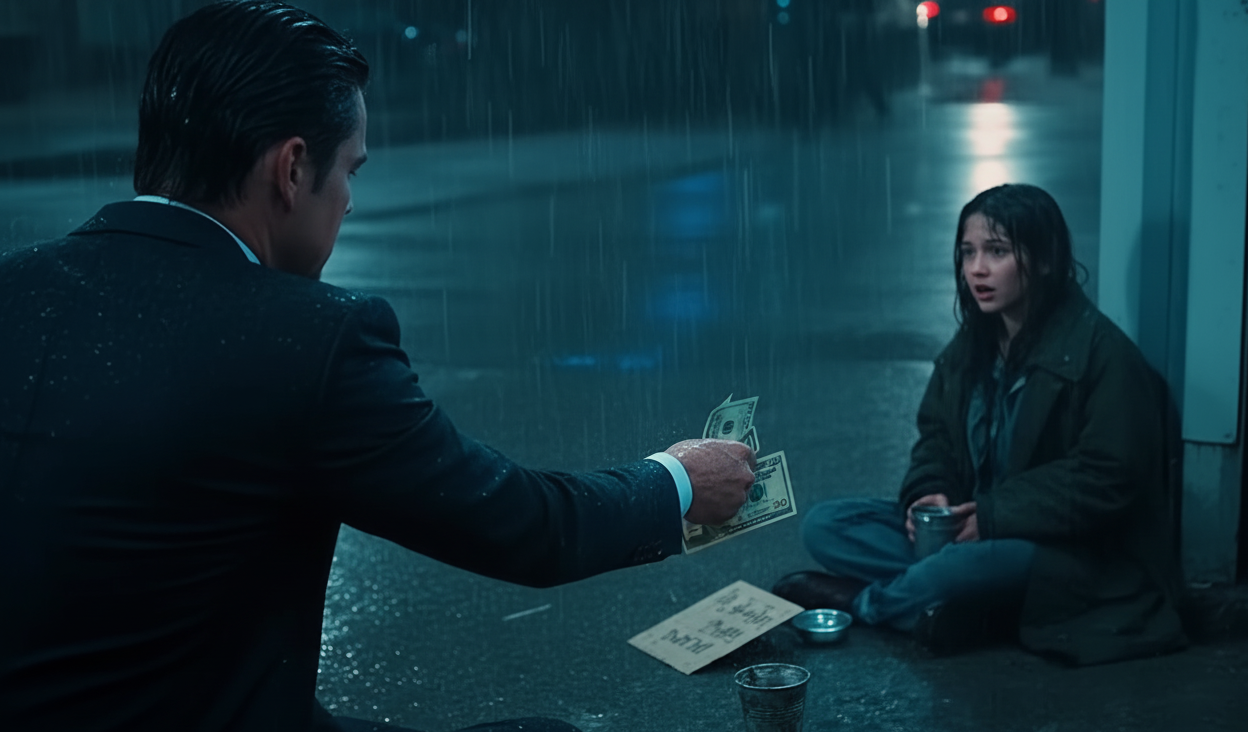
Elena wrote it three days before the crash. Never recorded it. Only sang it to me when my nightmares came back. “Marcus. Unlock the doors.” “Sir, it’s pouringโ” “Now!” I shoved the door open and ran into the rain. She was under a boarded-up storefront awning. Maybe ten years old. Wearing a men’s coat five sizes too big, sleeves rolled up, hair plastered to her pale face. Plastic cup.
A few pennies. People rushed past like she didn’t exist. But she kept singing, eyes closed, head tilted back. “Wait for me in the morning lightโฆ wait for me, I knowโฆ” When she opened her eyes, I saw them. One hazel. One blue. Elena’s eyes. I stood there, a billionaire in a three-thousand-dollar suit, shaking in the rain. Not from cold. From seeing a ghost. — The girl stopped singing.
Pressed back against the graffiti-covered wall, clutching her cup. “I’m not begging,” she stammered. “I’m selling a performance. It’s legal.” “Where did you learn that song?” She blinked water from her lashes. “What?” “That song. Who taught you?” “My mom. Before she left.”
Her stomach growled. Loud, angry. She wrapped her arms around herself, ashamed. I looked down. Sneakers splitting at the toes, wrapped in duct tape. Empty honey bun wrapper beside her feet. “You’re hungry.” “I’m fine.” “I can buy you food. Just tell me your name.” She studied me. Weighing risk. Starvation versus stranger danger. “Mia.” “Okay, Mia. That’s my car.” I pointed to the Maybach.
“I’m getting sandwiches from that bakery. Will you wait?” She looked at Le Pain Quotidien, glowing warm and yellow. “Why do you care?” “Because I haven’t heard that song in ten years. And I’d pay everything I have to hear it again.” She saw the grief in my face. Kids who grow up hard can smell trauma. “Turkey club,” she said, chin up. “And hot chocolate. With whipped cream.”
Before I could move, a rusted pickup screeched to the curb, splashing dirty water everywhere. A woman stumbled out. Thin, frantic, waitress uniform. Gaunt face, wide eyes. “Mia! Get in the truck! Now!” Mia went pale. The defiance vanished. “Aunt Brenda. I didn’t make enough yet. It’s raining, nobody’s stoppingโ” “I don’t care!” Brenda grabbed Mia’s collar.
“Forty dollars or you don’t come home! Who’s this?” She spun on me. Didn’t see a widower. Saw a wallet. “He was bothering me,” Mia lied instantly, trying to protect me. “Yeah?” Brenda stepped close. Cigarettes and cheap perfume. “You yelling at my kid, rich boy?”
I straightened. The Julian Thorne who crushed boardroom deals resurfaced. “I was offering dinner. Something you clearly haven’t done.” Brenda’s face twisted. She shoved Mia toward the truck. “Get in.” “Wait.” I reached into my soaked jacket, pulled out my money clip. Didn’t count. Tossed the whole thingโtwo thousand dollarsโat her feet. Brenda stared. Then that greedy grin split her face.
“Compensating for something?” She snatched it up, dirt and all. “Keep it. But if I see her begging again, I’m calling the cops.” Brenda laughed, harsh and barking. Jumped in the truck. As it peeled away, I saw Mia’s face pressed against the dirty glass. Mouthing: “Thank you.” I stood there until the taillights disappeared. “Mr. Thorne?” Marcus held an umbrella. Too late. “Sir, you’re shivering.”
I wasn’t cold. “Get the license plate.” “Already did, sir.” “Find where they live. Cancel my London flight.” “Sir?” “I’m not going anywhere. I found her.” — By midnight, I had a file. Marcus was ex-Special Forces. He still had contacts. “Brenda Kowalski. Age 42. Multiple arrests. Petty theft, check fraud, child endangerment.” The mugshot showed the same hard eyes. “The girl?” “Mia Kowalski.
Age 10. Niece. Mother’s listed as Sarah Kowalski.” I frowned. “Sarah?” “Brenda’s younger sister. Died in childbirth ten years ago. State hospital.” Ten years ago. Same timeline as Elena’s death. But Elena was an only child. Or so she’d told me. “Where do they live?” “Ironwood Trailer Park. South side, near the industrial district. Not a good place, Julian.” I grabbed my coat. “Get the car.”
“It’s midnight. You can’t walk into Ironwood in a suitโ” “I don’t care. She’s sleeping in a place run by someone who makes her beg in the rain. I’m not waiting.” — Ironwood was a scar. Rusting metal boxes, razor wire fences, barking dogs on chains. Burning trash and diesel fumes. The Maybach crept through potholes. We stood out like blood on snow. “That’s the truck.” Parked crooked in front of trailer 409. Windows covered in tin foil. Siding peeling off in strips. I didn’t wait for Marcus. Stepped into the mud. TV blaring inside. Drunk laughter. I pounded on the aluminum door.
“Police?” A man’s voice. Rough. “No. Open the door.” A lock tumbled. A large man in a stained undershirt blocked the doorway, holding a beer. Behind him, Brenda sat on a torn sofa, counting my wet cash. “Who the hell are you?” “The man who paid for your beer tonight.” I pushed past him. “Hey!” Brenda jumped up, stuffing cash in her bra. “You can’t justโ” “Where is she?”
“She’s sleeping. Get out before I call the cops.” “Go ahead. I’d love to explain why a ten-year-old was working a street corner at 9 PM.” Brenda hesitated. She couldn’t win that fight. “What do you want?” “I want to see her.” She pointed a jagged fingernail toward a narrow door. “She’s in her room.” I walked over. Pushed it open. Not a room. A closet. No bed. Just blankets on the floor.
Damp walls. Single bulb. Mia was curled up, still in that oversized coat. Shivering in her sleep. But what broke me was the photograph taped to the wall. Two women on a beach. Wind in their hair. Laughing. One was a strangerโSarah, presumably. The other was Elena. My knees hit the floor. Mia gasped awake, scrambling back into the corner. “It’s okay. It’s me. From the bakery.”
She stared at me with those mismatched eyes. Looked at the photo. Back at me. “You knew her,” she whispered. “She was my wife.” “She’s my Auntie. My mom said Auntie Elena was the only one who loved us.” The pieces slammed together. Violent. Sharp. Elena had a secret sister. And this girl was my family. “Get up, Mia.” “What?” “You’re not sleeping here. Not tonight. Not ever.”
“Hey!” Brenda appeared, the large man behind her. “That’s kidnapping!” I turned. The sadness was gone. Just cold rage. “Marcus.” Marcus stepped into the hallway, filling it. Jacket unbuttoned enough to show the shoulder holster. “Handle the trash. I’m taking my niece home.” — The drive to Medina was silent. Heavy silence. Mia sat far away, clutching her dirty coat.
Every bump made her flinch. “You have a big house,” she whispered when we pulled through the gates. “It’s too big. It echoes.” Inside, she stopped on the marble floor. Looked at her muddy sneakers. Tried to step back outside. “I’m getting it dirty.” I knelt down. “You can walk anywhere. Paint the walls with mud if you want. This is your home now.” “Nothing’s free. Brenda said.
What do I have to do?” “Just be a kid. And maybe tell me about your mom. When you’re ready.” Later, I found her by the open fridge, eating cold pasta straight from the container. Fast. Eyes darting. She was eating like she didn’t know when the next meal would come. I didn’t stop her. Just leaned against the counter. “The chef makes pancakes in the morning. Whatever you want.” She paused, noodle hanging from her lip. “I like strawberry.” “Then strawberry it is.” She swallowed.
“Why didn’t Auntie Elena tell you about me?” A knife in my chest. “I don’t know. But I’m going to find out.” — That night, after Mia locked herself in the guest roomโa habit that would take years to breakโI went to the West Wing. I hadn’t entered in five years. Elena’s music room. A Steinway piano under a dust sheet. I pulled it off. Pressed Middle C. The note rang out. Lonely. Sharp. Why, Elena? My hand brushed the underside of the bench. Felt something. Tape. Elena used to hide things. A game we played. I peeled back an envelope. Addressed to: “Julian. For when I’m brave enough.”
Three letters inside. And Mia’s birth certificate. “My Dearest Julian,” the first began. Shaky handwriting. “If you’re reading this, I finally told you. Or I’m gone. I hope I told you.” “I lied. I’m not an only child. I have a sister, Sarah. My parents disowned her when she got pregnant at sixteen. Threw her out to protect the Vanderwaal name.” I gasped. The Vanderwaals. Old money. Ruthless East Coast elite. Elena had told me she came from nothing. “I tried to help her. But my father threatened me. Said if I told you, he’d destroy your career. He’d bury us in scandals. I was scared, Julian.
I wanted to protect you. So I kept them secret.” “Sarah just had a baby. Mia. She has my eyes. I’m meeting them next week. I’m bringing them home. I don’t care about threats anymore. We’ll fight my father together.” The date: October 14th, 2014. The day before Elena died. She wasn’t driving to a spa. She was driving to get Sarah and Mia. The crash orphaned Mia and left me alone. I looked up, tears streaming. “I would’ve fought the world for you, Elena.” Now I knew my mission. Finish my wife’s last wish. — Peace lasted forty-eight hours. Third morning, Mia was laughing at Marcus juggling oranges, eating strawberry pancakes with a knife and fork. The house felt alive. Then the intercom buzzed.
“Mr. Thorne. Police are here. And a lawyer. They have a warrant.” My blood froze. “Don’t let them in.” “Sir, they say it’s about a kidnapping.” Mia dropped her fork. The clatter echoed. “Is it Brenda?” “Stay here. Marcus, don’t let anyone touch her.”
Two officers burst through the door. A man in a cheap suit. And behind them, Brenda. She’d cleaned up. Modest dress. Brushed hair. Playing the grieving aunt. “That’s him!” She pointed. “He stole my baby!” “Mr. Thorne.” The officer looked uncomfortable. He recognized me. “We have a report you forcibly removed a minor.” “I removed a child from abuse. She was sleeping in a closet.
Begging in the rain.” “Lies!” The cheap-suit lawyer cut in. “My client is struggling with poverty. You’re a billionaire who thinks he can buy people. Felony.” “Where is she?” Brenda shouted. “Mia! Baby! Come to Auntie!” From the dining room: “No! I don’t want to go!” The officer looked at me. “You have no legal standing. No custody papers. We have to return her.
Fight it in court. But right now, you’re bordering on arrest.” “She’s my wife’s niece. I have proof.” “Doesn’t matter now,” the lawyer smirked. “No custody rights. Hand her over. Or jail.” I looked at Brenda’s smug face. She didn’t want Mia. She wanted the payout. But I couldn’t let Mia go back. Not for an hour. “Marcus. Bring the car around back.” “Sir?” The officer’s hand went to his holster. “Don’t do anything stupid.” “I’m not.” I pulled out my phone. “I’m calling the Governor. And the best family law firm in the state. But until then…” I looked at Brenda. “How much?” Silence. “Excuse me?”
The lawyer blinked. “You don’t want the girl. You want money. How much to sign temporary guardianship right now? Until court.” Brenda’s mask slipped. The predator returned. She licked her lips. “Fifty thousand.” “Done. Write it down.” “Brenda!” Her lawyer hissed.
“Shut up! We can get millions!” “Fifty thousand cash. Right now.” I turned to the officer. “You hear that? She’s selling the child. Is that legal guardianship or trafficking?” The officer’s face hardened. “Ma’am, did you just offer to sell custody?” Brenda paled. “No, I… he offered…” “Get out of my house. Officer, remove these trespassers. I’ll see them in court. And I will bury them.”
Brenda scrambled back. But as police ushered them out, she screamed: “This isn’t over, Thorne! The Vanderwaals know! I called them! Her grandfather’s coming for her too!” The door slammed. The Vanderwaals. Elena’s parents. The people who destroyed her sister. I’d handled Brenda. Now I was going to war with real monsters. — They didn’t wait for court.
People like the Vanderwaals buy verdicts before gavels hit. Two days later, three black SUVs rolled through my gates. I’d sent Mia to the greenhouse with Marcus. She was planting strawberries. I didn’t want her to see sharks. Richard Vanderwaal walked in. Seventy. Expensive suit. Silver lion’s head cane. Wife Catherine behind him, Botox face frozen in disdain. I hadn’t seen them since Elena’s funeral. They hadn’t cried then. Wouldn’t now. “Julian. You look tired.”
“Surprised you came personally. Usually send lawyers.” “This is family business,” Catherine said, inspecting my foyer. “We’re here to collect our granddaughter.” “Granddaughter?” I laughed without humor. “For ten years she was a mistake you let rot in a trailer. You disowned Sarah. Let her die alone.” Richard slammed his cane on the marble. The sound echoed violently. “We did what was necessary to protect this family’s name! Sarah brought shame. And now you have this child creating noise. Gossip.
We don’t like noise.” “So you want to hide her. Ship her to boarding school in Switzerland so the world doesn’t know about your illegitimate heir.” “We’re offering courtesy,” Richard sneered. “Hand her over, we walk away. Refuse, and we bury you. I know about your merger next month. One phone call kills it. I’ll drain your assets, Julian. You’ll end up on the street with that brat.”
Valid threat. The Vanderwaals had establishment money. Banks. Senators. But I had something stronger. “I found the letters, Richard.” Deadly silence. Catherine’s face twitched. “What letters?” “Elena wrote before she died. Detailed everything. How you threatened her. Blackmailed her to keep Sarah secret. Told her if she helped her sister, you’d destroy my career.”
I pulled a photocopy from my jacket. Held it up. “October 14th, 2014. ‘My father says he’ll ruin Julian if I bring Sarah home. But I can’t let my niece starve.’” I looked at Richard. Color drained from his face. “Dated the day before the crash. The world thinks Elena died in a tragic accident. But if I release this? Show the great philanthropist Richard Vanderwaal drove his daughters to their deaths for reputation?” I stepped forward. “Your stock tanks. Your board ousts you.
You’re a pariah from here to the Hamptons. Care about your name? I’ll burn it to the ground.” Richard stared. His hand on the cane trembled. Looked at Catherine. She looked away. They knew a dead beloved daughter’s final words would be a PR nuclear bomb.
“What do you want?” “Sign the papers. Full relinquishment. You never see her. Never speak to her. Never mention her name.” “And the letters?”
“Stay in my safe. Insurance. As long as Mia’s safe and happy, your secret dies with me.” Richard glared with pure hatred. Then walked to the table. Signed with a furious scrawl. Catherine followed. Without a word, they left. Didn’t ask to see Mia. Didn’t ask if she was happy. They just wanted to escape the truth. I watched the SUVs drive away. Sat on the stairs, clutching the papers.
“Mr. Thorne?” Mia stood at the hallway entrance, holding a basket of strawberries. Hands covered in dirt. Marcus behind her, smiling. “Are the bad people gone?” I smiled through tears. “Yes, Mia. Gone for good.” — Six months later. Seattle Symphony Hall. Sold out.
Chandeliers glittered above tuxedos and evening gowns. I sat center box, adjusting my tie. Not checking my phone. Not looking at stock prices. Leaning forward. Hands clasped. The conductor raised his baton. The orchestra went silent. A small figure walked onto the stage. Mia wore a midnight blue dress that shimmered under the spotlight. Hair clean and curled. Face healthy and full of color. Not the street urchin in a men’s coat anymore. A princess. She walked to the microphone.
Looked at the vast darkness of the audience. For a second, I saw the old fear. I stood up. Breach of etiquette. Didn’t care. I wanted her to see me. I nodded. I’m here. Not leaving. Mia saw me. Took a breath. Signaled the pianist. She didn’t sing opera. Didn’t sing a classic. She sang the song. “Sleep now, the stars are fadingโฆ the moon has lost its glowโฆ” Her voice soared through the hall. Clearer. Stronger than in the rain. Not just a child singing. A soul pouring out years of pain and finding release.
The audience was mesmerized. No coughing. No rustling. Just the pure, haunting sound of Elena’s melody coming back through the daughter she died trying to save. “Wait for me in the morning lightโฆ wait for me, I knowโฆ” When she hit the high noteโthe one that stopped my car six months agoโit wasn’t a cry for help. It was a victory cry. A declaration that she survived the storm.
I closed my eyes. For the first time in ten years, I didn’t see the crash. I saw Elena. Standing on a beach. Wind in her hair. Smiling. She wasn’t waiting for me to join her in death. She was watching us live. The song ended. The final note hung, shimmering. Three seconds of silence. Then the hall erupted. People on their feet. Clapping. Cheering. Some wiping tears.
Mia beamed. Looked up at my box and waved. I waved back. Heart full. Ghost finally laid to rest. I’d stopped my car to save a homeless girl. Didn’t realize she was saving me. The rain had stopped. The morning light was finally here.
They shoved my daughter down the stairs for a viral videoโฆ But they didnโt know her father had just returned from combat โ and he didnโt come alone.
Gravity doesnโt ask permission. It just takes.
I was standing at the top of the West Wing stairs at Oakridge High when it happened.
Lunch bell still echoed through the building. Lockers slammed shut. The air smelled like cheap perfume layered over disinfectant โ sweet, sharp, familiar. That scent always meant Chloe was nearby.
I felt the shove before I heard the laughter.
A hard push between my shoulder blades.
My sneakers slid on the polished tile. My sketchbook โ charcoal portraits, all of them of my dad in different uniforms, different years โ flew from my hands.
Then the stairs swallowed me whole.
Shin. Hip. Shoulder.
Twelve steps of pain.
My body tumbled like a ragdoll, brown arms flailing, curls whipping across my face, until the landing knocked the breath from my lungs. I tried to scream, but nothing came out. Just a sharp gasp and ringing ears.
Above me, laughter poured down like rain.
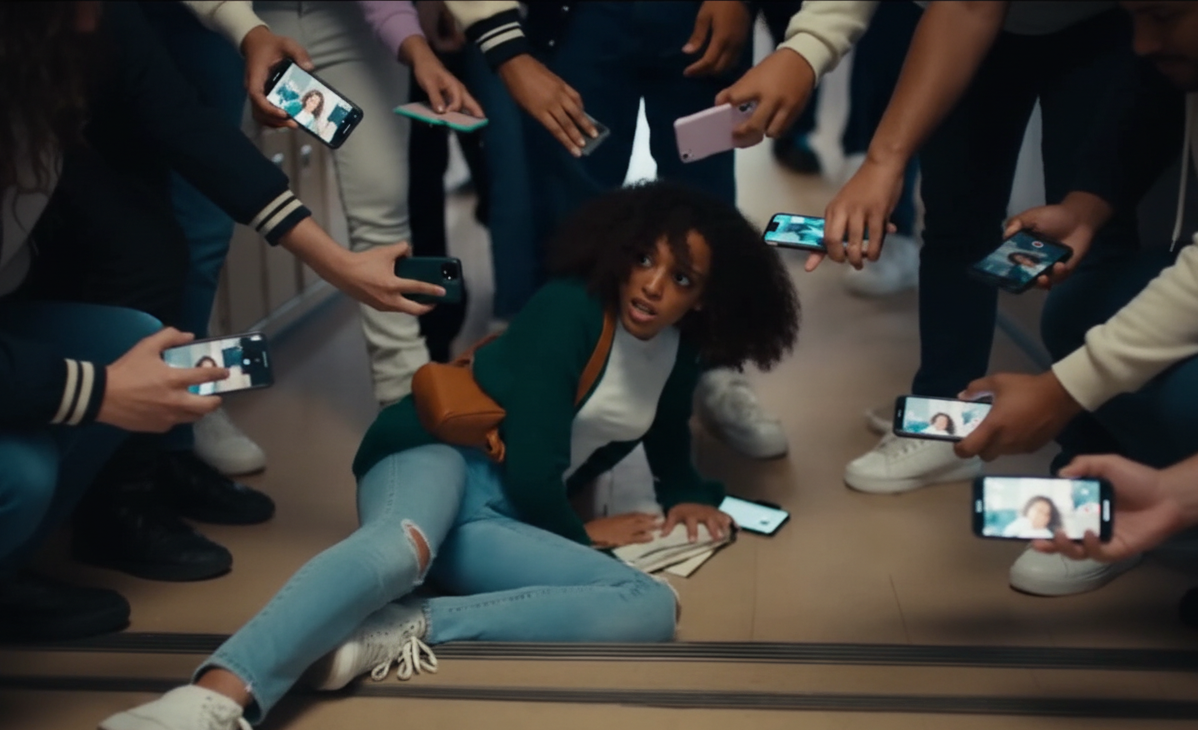
โDid you get it?โ Chloe shrieked.
โPerfect angle,โ Sarah said.
I tried to move. My ankle exploded with pain. I looked up.
Three girls. Phones raised. Camera lights blinking.
Not help.
Content.
โPlease,โ I croaked.
Chloe leaned over the railing. She was pale, blonde, perfect โ everything Oakridge loved. She zoomed in on my face, swollen already.
โAww,โ she said. โPost it. #ClumsyLoser.โ
I curled inward, dark skin scraped raw against the tile, wishing I could disappear. Wishing my dad wasnโt halfway across the world. Wishing being quiet, being mixed, being invisible had ever actually protected me.
Then the sound changed.
Not sneakers.
Boots.
Heavy. Measured. Intentional.
Thud. Thud. Thud.
The glass doors at the end of the hall swung open.
Seven men stepped inside.
They moved like one body.
Dust clung to their boots. MultiCam uniforms. American flags stitched to their shoulders. Sun-darkened skin on some, lighter brown on others โ a brotherhood forged somewhere far louder than a high school hallway.
The noise died instantly.
At the center walked my father.
Sergeant Major Marcus Bennett.
Tall. Broad shoulders. Skin the color of warm mahogany. Close-cropped hair just beginning to gray at the temples. Eyes sharp enough to cut steel.
He wasnโt supposed to be home for two more weeks.
He saw me immediately.
Father turned Soldier in a heartbeat.
He dropped to his knees beside me, hands suddenly gentle, cradling my face like I was glass. โIโve got you,โ he said, voice low and steady. โIโve got you, baby.โ
Behind him, his squad spread out, forming a wall without being told.
A camera flash popped.
Chloe was still filming.
โWhoโs that hobo?โ she laughed nervously.
My father stood.
Slowly.
The hallway seemed to shrink around him.
โWho,โ he said, his voice calm but carrying like thunder, โpushed my daughter?โ
No one answered.
Chloeโs phone slipped from her fingers, bouncing down the steps until it stopped at his boots.
He crushed it under his heel.
Didnโt look away.
โI donโt repeat myself.โ
As he climbed toward them, step by deliberate step, Doc โ the medic โ was already kneeling beside me, hands sure, voice calm.
โPossible concussion,โ he said. โAnkleโs bad.โ
At the top landing, Chloeโs face drained of color.
She tried to back away.
She ran into muscle.
Tex and Tiny blocked the corridor effortlessly.
โGoing somewhere?โ Tex asked, polite as Sunday dinner.
My father stopped inches from Chloe.
Didnโt yell. Didnโt threaten.
Didnโt need to.
โIn my unit,โ he said quietly, โwhen someone falls, we pick them up. We donโt laugh. We donโt film.โ
A teacher rushed forward. โSir, you canโtโโ
My father turned once, eyes steady, controlled. โThis is assault.โ
He faced Chloe again.
โYouโre going to help her.โ
With shaking hands, the girls lifted me. My weight felt heavier with every step โ guilt has gravity too. Students lined the hallway, phones raised, but not for me.
For them.
For the impossible image of bullies carrying the girl they broke.
In the nurseโs office, my father stopped them.
โWeโll wait for the principal,โ he said. โAnd the parents.โ
Chloeโs mother arrived like a hurricane in heels and silk, outrage blazing.
She took one look at my fatherโs uniform, then at my brown face wrapped in ice, and sighed sharply.
She reached for her checkbook.
โHow much?โ she snapped.
My father didnโt blink.
He placed a flash drive on the desk.
โHallway cameras,โ he said. โDeleted cloud footage. Planning. Laughter. The push.โ
Her hand froze.
โFelony assault,โ he continued. โPremeditated.โ
Silence swallowed the room.
โExpulsion,โ my father said. โOr the police. And the media.โ
The checkbook sagged.
She nodded.
โOne more thing,โ my father added, turning to Chloe. โA video. The truth. Public.โ
Chloe sobbed.
Then she recorded it.
We walked out into the sunlight together โ my father on one side, Doc on the other.
The squad peeled away at the curb, grinning, bumping fists, ruffling my curls.
At home, my father handed me my battered sketchbook.
โIt survived,โ he said, writing inside the cover:
To Maya โ the strongest soldier I know.
My phone buzzed.
Chloeโs apology was live.
I set the phone down and picked up my pencil.
I looked at my father โ dusty boots, tired eyes, unbreakable love.
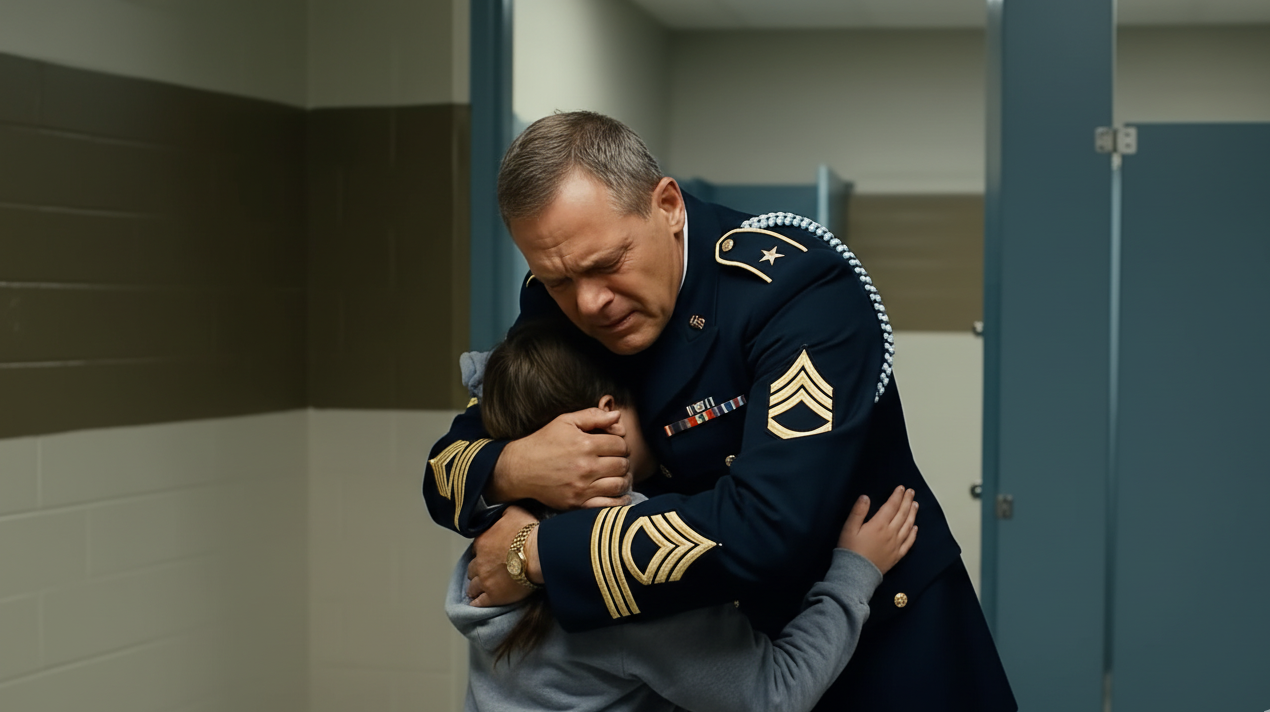
Bullies locked a Colonel’s daughter in the bathroom for an entire classโฆ What he did when he arrived at school left the principal speechless. Full story in the comments.
Colonel James Mitchell had spent twenty-three years defending his country. He’d survived two tours in Afghanistan, led soldiers through impossible situations, and earned more medals than he could count. But nothingโabsolutely nothingโprepared him for the war his twelve-year-old daughter Emma was fighting alone in the hallways of Riverside Middle School.
It started in September, subtle at first. Emma’s favorite notebooks went missing. Her locker was covered in cruel graffiti. She’d come home quieter each day, retreating to her room the moment she walked through the door. Her mother, Sarah, noticed firstโthe way Emma flinched when her phone buzzed, how she’d started wearing baggy hoodies to hide herself, the fake smile she’d paste on when they asked about her day.
“Just normal middle school stuff,” Emma would say, but her eyes told a different story.
The bullies were a group of four girls led by Madison Parker, whose father sat on the school board. They were calculated in their cruelty. They’d shove Emma into lockers when teachers weren’t looking, spread vicious rumors about her family, destroy her homework assignments. They called her “Army Brat” and “Wannabe” and worse things Emma refused to repeat to her parents.
Emma tried to handle it herself. She was a military kidโtough, resilient, taught to adapt and overcome. She reported incidents to teachers, who’d say, “Just ignore them, honey.” She went to the guidance counselor, who suggested she “try to understand where they’re coming from.” She even confronted Madison directly, which only made things worse.
The breaking point came on a Tuesday in late November.
The bullies cornered Emma between classes, shoving her into the girls’ bathroom. Madison stood guard at the door while the others taunted her, filming on their phones as Emma tried not to cry. Then Madison locked the door from the outside with a makeshift wedge, trapping Emma inside for the entire next period.
Emma pounded on the door until her hands hurt. She called out until her voice went hoarse. No one came. She sat on the cold tile floor, hugging her knees, feeling more alone than she ever had in her life. When a janitor finally found her seventy minutes later, Emma walked to the nurse’s office in silence, called her mother, and said just four words: “Mom, I need Dad.”
That evening, Emma finally broke down. She showed her parents everythingโthe videos she’d secretly recorded on her phone over the past three months. Shoves in the hallway. Destroyed belongings. Cruel whispers captured on audio. Messages and posts spreading lies about her. The bathroom incident. All of it, documented with timestamps and dates.
James Mitchell watched each video with the same controlled expression he’d worn during mission briefings in Kandahar. But inside, a father’s rage was building like a storm.
“Why didn’t you tell us sooner, sweetheart?” Sarah asked gently.
“Because I didn’t want to be weak,” Emma whispered. “You’re both so strong. I thought I should be too.”
James pulled his daughter close. “Asking for help isn’t weakness, Emma. It’s strategy. And now we’re going to deploy some.”
The next morning, Colonel Mitchell walked into Riverside Middle School in his full dress uniformโthe one with all the medals, the one that commanded respect in any room. Emma walked beside him, her hand in his, her spine a little straighter than it had been in months.
They went straight to Principal Warren’s office. The secretary tried to stop themโ”He’s very busy this morning, you’ll need to scheduleโ”
“I don’t need to schedule anything,” James said calmly but firmly. “Tell him Colonel Mitchell is here regarding the ongoing assault of his daughter, and he has exactly two minutes to make himself available.”
Principal Warren appeared almost immediately, his smile patronizing. He was a soft man in his late fifties who’d never faced anything more challenging than budget meetings and parent complaints about homework loads.
“Colonel Mitchell, of course, please come in. I understand Emma had a little incident yesterdayโ”
“A little incident?” James’s voice could have cut steel. “My daughter was imprisoned in a bathroom for over an hour by students who have been systematically tormenting her for three months. That’s not an incident. That’s assault and false imprisonment.”
Warren waved his hand dismissively. “Now, Colonel, I know military life can be stressful, but we need to keep perspective. These are just kids’ problems. Girls this age can be dramatic. They’re just jealous of Emmaโit’ll pass. It always does.”
Sarah, who’d been silent until now, spoke up. “My daughter has documented bruises. She’s developed anxiety. She’s talked about not wanting to go to schoolโ”
“Mrs. Mitchell, I appreciate your concern, but I’ve been an educator for thirty years. I know how middle school girls operate. This is just a phase. Emma needs to develop thicker skinโ”
That’s when James Mitchell opened his daughter’s phone and placed it on the desk.
“These are just kids’ problems?” He pressed play on the first video. The sound of Emma being shoved into a locker, her books scattering. Madison’s voice: “Stay down where you belong, loser.”
James played another. And another. Three months of documented abuse, each video more damning than the last. The bathroom incident played out in real-time audioโEmma’s pleas, the girls’ laughter, the sound of her eventually crying alone.
The principal’s face had gone pale.
“Here’s what’s going to happen,” James said, his voice military-calm, which was somehow more terrifying than shouting. “Copies of every single one of these videos have already been sent to my lawyer, to the school district superintendent, to the school board, and to my contact at the local news station. My lawyer has prepared a detailed case documenting the school’s negligence and failure to provide a safe learning environment for my daughter.”
He leaned forward slightly. “You have two options, Principal Warren. Option one: You take immediate and decisive action today. The students involved are suspended pending a full investigation. The teachers who ignored my daughter’s complaints are formally reprimanded. A comprehensive anti-bullying policy is implemented schoolwide. Emma receives a written apology, and her safety is guaranteed.”
James let the silence hang for a moment.
“Option two: I act tomorrow. My lawyer files suit against the school, the district, and you personally for negligence and creating a hostile environment. Those videos go public. The news stationsโwho love stories about military families being failed by institutions they trustโwill run it on every evening broadcast. The school board, which I’m told includes the father of the ringleader, will have some very uncomfortable questions to answer about why they allowed this to continue.”
Principal Warren’s hand trembled slightly as he reached for his desk phone.
“I’ll also be filing formal complaints with the state education board,” James continued. “And I’ll be requesting a full audit of how this school handles bullying complaints. Given that multiple staff members ignored my daughter’s repeated reports, I suspect this isn’t an isolated incident.”
Warren looked like he might be sick. “Colonel Mitchell, there’s no need forโ”
“There’s every need. My daughter has spent three months in hell because the adults responsible for her safety decided it was easier to look away. Because you decided the daughter of a school board member was more important than a military kid who’d eventually move away anyway. That ends today.”
Emma squeezed her father’s hand. For the first time in months, she felt like someone actually heard her.
“So what’s it going to be, Principal Warren?” James asked. “Do you act today? Or do I act tomorrow?”
The principal picked up his phone with shaking hands. “Get me the district superintendent. Now.”
What followed was a whirlwind. Madison and her three accomplices were suspended for two weeks, pending a full investigation. Their parents were called in for mandatory meetings. The teachers who’d ignored Emma’s complaints received formal reprimands in their files. Principal Warren himself was placed on administrative leave while the district reviewed his handling of the situationโa leave that would become permanent reassignment to a district office position by Christmas.
A school-wide assembly was held about bullying. A new reporting system was implemented. Counselors were brought in. Emma’s storyโwithout her nameโbecame a case study in what not to ignore.
But the moment that mattered most happened in the hallway after that first meeting.
Emma threw her arms around her father, tears streaming down her faceโbut this time, they were tears of relief. “Thank you for believing me, Dad. Everyone else said I was being dramatic or that it would pass, but you believed me.”
James held his daughter tight, this brave girl who’d endured months of torment and still showed up every day. “I will always believe you, Emma. Always. And I will always fight for you. That’s what parents do. That’s what soldiers do. We protect the people who can’t protect themselves.”
“I tried to protect myself,” Emma said quietly. “I really did.”
“I know you did, sweetheart. And you were incredibly brave. But you shouldn’t have had to fight this battle alone. The adults failed you, and that’s on us to fix.”
Sarah joined the embrace, and for a long moment, the Mitchell family stood together in that hallway, a united front against a world that had tried to break their daughter.
Over the following weeks, things changed. Madison and her friends stayed far away from Emma when they returned. Other studentsโkids who’d been silent witnesses to the bullyingโstarted saying hello to Emma in the halls. A few even apologized for not speaking up. Emma made new friends, real friends who appreciated her strength and kindness.
She still had tough days. Three months of trauma doesn’t vanish overnight. But she had her family, she had justice, and most importantly, she had her voice back.
On Veterans Day, Emma’s class did presentations about family members who served. When Emma stood up to talk about her father, she didn’t just talk about his medals or his deployments.
“My dad taught me that courage isn’t just what you do on a battlefield,” she told her classmates. “It’s standing up when institutions fail. It’s believing someone when no one else will. It’s fighting for what’s right, even when it’s hard. My dad’s a hero not just because he served our country, but because when I needed someone to believe me, to fight for me, to protect meโhe did. Without hesitation. That’s what real courage looks like.”
There wasn’t a dry eye in the classroom, including the new teacher’sโsomeone who’d been hired specifically because she had a background in trauma-informed education and took student safety seriously.
That evening, James found the video of Emma’s presentation on the school’s website. He watched it three times, this decorated colonel who’d faced down enemy combatants and life-threatening situations, wiping tears from his eyes at his daughter’s words.
Sarah found him in his office. “You okay?”
“I spent my whole career protecting strangers,” he said quietly. “But nothing I’ve ever done mattered more than protecting her. Nothing.”
“You did more than protect her, James. You taught her that her voice matters. That she deserves to be heard. That standing up for herself isn’t weaknessโit’s strength. She’ll carry that lesson her whole life.”
Months later, Emma would write an essay for English class about courage. She didn’t write about her father’s military service, though she was proud of it. She wrote about the courage it took to ask for help. The courage to document injustice even when you’re terrified. The courage to keep showing up even when every day feels impossible.
And she wrote about what real support looks likeโnot dismissing someone’s pain as “drama,” not telling them to “just ignore it,” not protecting bullies because their parents have influence. Real support is believing someone when they speak their truth. It’s taking action even when it’s uncomfortable. It’s using your power to protect those who have less power than you.
Her essay won a state-wide competition. The prize was a scholarship fund and an invitation to speak at a conference on school safety.
When Emma stood at that podium months later, a confident thirteen-year-old who’d survived her trial by fire, she looked out at the audience of educators, administrators, and policymakers and spoke the truth they needed to hear.
“When students come to you for help, they’re not being dramatic. They’re not overreacting. They’re asking you to do your job. And when you dismiss them, when you protect bullies, when you tell them it will passโyou’re teaching them that their safety doesn’t matter. That their voice doesn’t matter. That they don’t matter.”
She paused, letting that sink in.
“My father is a military officer. He fights for people he’s never met, in countries far from home. But when I needed him most, he fought for me. He believed me when others wouldn’t. He took action when others looked away. Every child deserves that. Every child deserves adults who will fight for them. Who will believe them. Who will protect them.”
“Don’t wait for a parent to walk into your office with evidence and legal threats. Act the first time a child asks for help. Because every day you wait is another day that child suffers. Another day they lose faith in the adults who are supposed to keep them safe. Another day they learn that their pain doesn’t matter.”
“Be the adult who believes them. Be the adult who acts. Be the adult who changes their life by simply listening and caring enough to do something about it.”
The standing ovation lasted five minutes.
And somewhere in the audience, Principal Davis of Riverside Middle Schoolโthe new principal who’d replaced Warrenโwiped tears from his eyes and made a silent promise to do better, to be better, to remember why he’d become an educator in the first place.
Because one father’s courage had sparked a daughter’s voice, and that voice was changing the system that had failed her.
That’s the real victory. Not just justice for one girl, but a movement toward protecting all of them.
He came home three days early from his business tripโฆ But what he saw through the kitchen doorway made his blood run cold.
The garbage disposal’s grinding roar masked my entrance. I stood frozen in my own foyer, the heavy oak door still open behind me, letting in the chill November wind. My driver had just pulled away into the darkness. I was three days earlyโthe Tokyo merger had closed faster than anticipated, a miracle in the corporate world.
I hadn’t texted. I hadn’t called. I wanted to surprise them. I wanted to see Victoria’s smile, hear Emma’s laugh, feel Thomas’s chubby arms around my neck.
I had been gone for two weeks this time. Fourteen days of board meetings, sterile hotel rooms, and the gnawing guilt that came with every missed goodnight call. I was missing their lives. Missing them growing up. But I was building this for themโthat’s what I told myself. That’s the lie every absentee father whispers to sleep at night.
I dropped my briefcase.
The sound was swallowed by that mechanical grinding from the kitchen.
From where I stood, I had a direct line of sight down the hallway into our open-concept kitchenโa space I’d spent a fortune renovating last year. Calcutta marble countertops. Wolf appliances. A space designed for family meals and Sunday pancakes and the life I thought we were living.
Victoria stood by the farmhouse sink in a black cocktail dress, her blonde hair swept up in that intricate style she only wore for parties. Her diamond tennis braceletโmy anniversary gift from three months agoโcaught the light as her hand moved furiously.
She was scraping a plate into the disposal.
Not just crumbs. I saw a perfectly cooked chicken leg, golden-brown and steaming. Roasted carrots glazed with honey. A mound of buttery garlic potatoes. An entire dinner, still hot, being destroyed.
“He didn’t eat!” Her voice wasn’t the melodic alto I’d fallen in love with. It was a hiss, sharp and jagged, scraping against my nerves like nails on stone. “I told you, Emma. If he doesn’t eat when I say it’s time, he gets nothing. That is the rule. I am not running a restaurant for ungrateful brats.”
I took a step forward, my dress shoes silent on the carpet. My heart hammered against my ribsโa primal warning that something was terribly, fundamentally wrong.
I shifted my gaze past Victoria to the corner of the kitchen near the pantry.
Emma was standing there. My eight-year-old daughter. My firstborn.
She looked… different. Wrong.
In our video callsโthe ones I squeezed in between meetingsโshe always sat on the beige sofa, smiling, telling me school was “fine” and that she missed me. But now, seeing her in the harsh reality of the kitchen lights, she looked gray. Diminished. Her oversized t-shirt hung off shoulders that seemed too narrow, too bony. Her hair, usually braided neatly by Victoria, was a tangled mess.
But it was what she was holding that stopped the breath in my throat.
She was clutching Thomas. My son. My baby boy.
He was eighteen months old. I had missed his first steps while closing a deal in London. I had missed his first wordโ”Dada”โwhile entertaining clients in Dubai. Victoria had sent me a video, and I’d watched it alone in my hotel room, crying into expensive whiskey.
The child in Emma’s arms didn’t look like the toddler from those photos Victoria texted me. The chubby-cheeked baby who smiled at the camera.
He looked skeletal. That is the only word for it.
His head seemed too large for his body, creating a grotesque disproportion that my mind couldn’t process. His pajama top had ridden up, revealing a stomach that wasn’t round with baby fat but distended and drum-tightโthe kind of distension I’d only seen in documentaries about famine. His arms were like twigs, his little wrists knobby with bone.
He was watching Victoria destroy the food with wide, sunken eyes.
He wasn’t crying. That was the worst part. He wasn’t screaming or throwing a tantrum like a normal toddler. He was making this high-pitched, mewling soundโa sound of pure, exhausted misery. The sound of someone who had learned that crying brought no help. He reached one skeletal hand toward the sink, fingers grasping at air, at hope, at food that was being ground to nothing.
“Please.” Emma’s voice was barely audible over the disposal’s roar. It was shaking so hard I could see her whole body trembling. “Victoria, please. He’s so hungry. He didn’t mean to spit it out. He’s just… he’s just little. Please let him have the bread at least. I’ll give him mine. I’ll give him all of mine. Just the bread.”
Victoria spun around, and I saw her face.
It was twisted with a rage I had never witnessed before. Her beautiful featuresโthe ones that had charmed investors and made heads turn at galasโwere contorted into something ugly and inhuman. It was a stranger’s face. A monster’s face.
“I said NO!” The scream was shrill enough to make me flinch in the foyer. She raised the spatula like a weapon, brandishing it at my eight-year-old daughter. “One more word out of you, and you go in the closet! Do you hear me? Do you want to spend the night in the dark again? Do you want the spiders?”
Emma flinched violently, her whole body jerking backward. She curled herself around Thomas protectively, turning her back to Victoria, shielding him with her own small frame.
The disposal finally gurgled and fell silent. The quiet that followed was somehow louder than the noise. In it, I could hear Thomas’s labored breathing, Emma’s suppressed sob, and the thundering of my own pulse in my ears.
“Victoria.”
I said her name. I didn’t shout. I couldn’t. All the air had left my lungs, replaced by something cold and terrible.
Victoria froze like someone had hit pause on a video. Her arm, still raised with the spatula, went rigid. Her back was to me, but I saw the tension snap through her shoulders, saw her spine stiffen.
Slowlyโagonizingly slowlyโshe turned around.
For a split second, her face was still contorted in that demonic snarl. But the moment her eyes locked onto mine, I watched the transformation happen. It was instantaneous. Professional. Practiced.
The snarl smoothed out like someone ironing silk. Her eyebrows lifted in mock surprise. Her lips curled into a wide, dazzling smileโthe one that had made me fall in love with her two years ago, six months after my wife Emily died.
“Michael!” Her voice was suddenly light, musical, delighted. She dropped the spatula on the marble counter with a clatter and took a step toward me, arms spreading wide. Her perfumeโChanel No. 5โwafted through the air, a scent I used to find intoxicating but now found suffocating. “Darling! You’re home! Oh my god, you scared me half to death!”
She laughedโthat breathless, bubbly laugh she used at charity events.
“I wasn’t expecting you until Monday! Why didn’t you call? I would have picked you up! I look a mess! Let meโ”
She reached for me, her perfectly manicured hands reaching for the lapels of my coat.
I stepped back so fast I almost tripped over my own briefcase.
“Don’t,” I said. My voice sounded foreign to my own ears. Hoarse. Rasping. Dangerous.
Victoria blinked, her smile faltering by just a fraction. “Michael? Honey, what’s wrong? You look pale. Are you sick? Was the flight terrible? Did something happen with the merger?”
She was ignoring it. Ignoring the scene behind her. Ignoring the starving children in the corner of her designer kitchen. She was trying to reset the stage, to pull me back into the play where she was the perfect wife and we were the perfect family and everything was fine.
I walked past her without a word.
I felt the heat radiating off her body as I passed, smelled her perfume mixed with something elseโwine, she’d been drinkingโbut I didn’t look at her. I couldn’t. If I looked at her, if I saw that false smile one more second, I might do something that would send me to prison for the rest of my life.
I walked straight to the corner where my children stood.
Emma was pressing herself into the wall like she wanted to disappear into it. Her eyes were wide with a terror that broke something fundamental in my chest. She looked at me, then her eyes darted to Victoria, then back to me. She was calculating. Strategizing. Trying to determine if I was safe or if I was another threat.
An eight-year-old child should not know how to strategize survival in her own kitchen.
“Emma,” I said softly, kneeling down on the cold tile floor.
“Daddy?” She whispered it like a question, like she wasn’t sure I was real. Like I might be a hallucination born of desperation and hunger.
“I’m here, baby. I’m home. I’m really here.”
I reached out slowly, telegraphing my movements, and touched Thomas’s arm.
The feeling made bile rise in my throat. There was no padding. No soft, toddler flesh. Just skin stretched tight over fragile bone, like touching a bird. His skin was cold and clammy.
He looked at me with eyes that were sunken in dark purple circles. He didn’t smile. He didn’t recognize meโwhy would he? I was a stranger who appeared on a screen sometimes. He just stared at me with a dull, heavy gaze that seemed to say, Are you going to hurt me too?
I took him from Emma’s arms as gently as I could.
He weighed nothing. He was eighteen months old, but he felt lighter than he had at six months. The diaper he was wearing sagged, heavy and soiledโhow long had he been in it? His little body was limp, unresisting, like he’d learned that fighting was pointless.
“Oh, Michael, don’t pick him up!” Victoria’s voice chirped from behind me, still trying to maintain the charade. “He’s been so sick, darling. A terrible stomach bug that’s been going through his daycare. It’s been awful. That’s why he looks so peaked, poor little thing. He hasn’t been able to keep anything down for daysโjust throwing up everything. That’s why I was tossing that dinner out. He refused to even try it, and I didn’t want it sitting out attracting flies.”
The lies slid off her tongue like oil. Smooth. Easy. Rehearsed. She’d probably been practicing them for weeks, preparing for this moment.
I stood up slowly, holding my son close to my chest. He felt so cold. Why was he so cold in a heated house?
I turned to face her.
“A stomach bug,” I repeated flatly.
“Yes!” She wrung her hands, the diamond bracelet clicking softly. “It’s been awful, Michael. Absolutely awful. Dr. Stevens said we just have to ride it outโkeep him hydrated, bland foods only. Toast and water, that’s what he recommended. I’ve been so worried. I haven’t slept in days taking care of him.”
Her performance was flawless. The concerned stepmother. The martyr.
“If he has a stomach bug,” I said, my voice dangerously calm, “why did I just watch you throw away a full roast chicken dinner? And why did Emma beg you for bread?”
Victoria’s eyes narrowedโjust for a second. A flicker of the predator beneath the skin, calculating her next move.
“Emma is…” She sighed, shaking her head sadly, the picture of maternal frustration. “She’s been acting out lately. Jealous of all the attention Thomas needs right now with being sick. She makes up stories for attention. Drama queen tendencies, just like herโ”
She stopped herself abruptly. Just like her mother. That’s what she wanted to say. Just like Emily.
“Just like a typical little girl her age,” she corrected smoothly, her smile never wavering. “She knows Thomas can’t have solid food right now. She was trying to give him bread earlier, which would have made him vomit. I was protecting him, Michael. I’m always protecting them.”
I looked down at Emma. She was trembling so hard her knees were knocking together, making a soft sound against each other.
“Emma,” I said quietly. “Tell me about Thomas’s stomach bug.”
Emma stared at the floor. She wrapped her thin arms around herself, making herself smaller.
“Emma, sweetheart,” Victoria said, her voice taking on a sharp edge disguised as sweetness. “Answer your father. Tell him how sick Thomas has been. Tell him about all the vomiting.”
The threat hung in the air like smoke. I could see Emma receiving it, processing it, weighing her options.
“He… he threw up,” Emma whispered to the floor.
“See?” Victoria beamed triumphantly, spreading her hands. “I told you, darling. I wouldn’t lie about something like this.”
“Last week,” Emma finished, her voice barely audible. “He threw up last week. One time. Because he ate toothpaste from the bathroom. Because he was so hungry he was eating toothpaste.”
The silence that crashed into the room was absolute and suffocating.
Victoria’s smile vanished like someone had flipped a switch.
I stared at my wifeโthis woman I thought I knew, this woman I’d brought into my home, into my children’s lives.
“He ate toothpaste,” I repeated slowly. “Because he was hungry.”
“She’s lying!” Victoria’s voice rose sharply, losing the melodic quality. “She’s a liar, Michael! She’s been difficult ever since you left for Tokyo! She hates me! She’s always hated me! She’s trying to turn you against me because she’s a jealous, spiteful littleโ”
I walked over to the garbage disposal, cutting off her rant. I reached into the rubber flange, ignoring the slime and the bits of ground food, and pulled out a piece of chicken she hadn’t managed to grind down completely yet.
It was perfectly cooked. Seasoned with rosemary and lemon, the way I liked it. Still warm.
“You were throwing this away,” I said, holding up the piece of food. My hand was shaking. “While my son is starving. Look at him, Victoria. Look at him!”
I turned Thomas toward her, this skeletal child who barely had the energy to hold up his own head.
“He looks like a concentration camp victim! You think I’m blind? You think I’m stupid? You think I wouldn’t notice that my son is dying?”
“He’s SICK!” she shrieked, her composure finally shattering completely. She stamped her foot like a child throwing a tantrum. “Stop interrogating me like I’m some criminal! I am his mother! I’ve been taking care of him while you were off playing businessman! Where were you? Where were you when he was vomiting? Where were you when Emma had nightmares? You were in Tokyo! You’re never here! And now you come home and accuse meโ”
“You are not his mother,” I roared, and the sound echoed off the marble surfaces. Thomas whimpered against my chest, startled by the noise. “You are his stepmother. And right now, you look a hell of a lot like his abuser.”
I turned back to Emma, forcing my voice to soften.
“Go upstairs,” I told her gently but firmly. “Pack a bag. Just the essentialsโclothes, your teddy bear, anything important. We are leaving. Right now.”
“Michael, you can’t be serious!” Victoria gasped, moving to block the hallway. Her eyes were wild now, the mask completely gone. “You’re not taking my children! It’s late! They need their routines! You’re being hysterical! You’re jet-lagged! You don’t know what you’re saying!”
“Move,” I said.
“No!” She planted herself in the doorway, arms spread. “This is my house too! You can’t just waltz in here after being gone for weeks andโ”
She grabbed my arm, her nails digging into the fabric of my suit jacket hard enough that I felt them through to skin.
I looked at her hand. Then I looked at her face.
“If you don’t move right now,” I whispered, leaning in close so she could see the absolute promise of violence in my eyes, “I will call the police. And I will have them inspect every inch of this house. I will have them check the pantry for those locks I’m starting to remember seeing. I will have them examine the children’s bodies for bruises. I will have them interview the neighbors, the teachers, the pediatrician whose appointments you’ve probably been canceling. Do you want that, Victoria?”
Her grip loosened. Her mouth opened, then closed. Fearโgenuine fearโfinally flickered behind those calculating eyes.
She stepped aside.
“Go,” I told Emma. “Run, baby. Pack fast.”
Emma ran, her bare feet slapping against the hardwood floors.
But as she ran past me, her oversized t-shirt slipped off her shoulder.
And I saw it.
On her upper arm, standing out dark purple and ugly against her pale skin, was a bruise. Noโfour bruises. In a distinct pattern.
The shape of four fingers and a thumb.
An adult handprint, as clear as a signature.
My vision actually went red at the edges. The world narrowed down to the sound of my own blood rushing in my ears and the woman standing in front of me in her designer dress and her diamond jewelry.
“Did you put your hands on her?” I asked. The question came out as a low growl, something barely human.
Victoria took a step back, hitting the counter. “She fell! She’s clumsy! She was running down the stairs and I grabbed her to stop her from falling! Michael, please, you’re scaring me!”
“I should scare you,” I said, advancing on her. She backed up further, knocking over a wine glass that shattered on the floor. “I should absolutely terrify you. Because right now, the only thing stopping me from putting my hands on you is the fact that my children have seen enough violence.”
I turned away from her before I did something I’d regret and headed for the stairs.
“You’ll regret this!” Victoria screamed after me. “I’ll tell everyone! I’ll tell them about your drinking! About how you’re never home! About how you couldn’t save Emily! I’ll destroy you, Michael! I’ll take everything!”
I kept walking, Thomas limp in my arms, Emma’s muffled sobs coming from upstairs.
I didn’t pack a bag. I didn’t wait for Emma to find shoes. I didn’t grab supplies or think about where we’d go.
I just knew we had to get out. Now.
I found Emma in her room, shoving a stuffed rabbit into her pink backpack with hands that shook so badly she could barely grip the zipper. When she looked up at me, her eyes were wide with terror, tears streaming down her cheeks.
“I’m sorry,” she sobbed. “I’m sorry I told. She’s going to be so mad. She’s going toโ”
“She’s never touching you again,” I said. “Come on. We’re leaving.”
“But my shoesโ” she whispered, looking at her bare feet.
“We’ll buy new ones. We’ll buy everything new. Come on.”
I scooped her up with one arm, still holding Thomas tight against my chest with the other. They were both so light. Too light. How had I not noticed on the video calls? How had I been so blind?
We went down the back stairs, avoiding the kitchen, avoiding Victoria who was now screaming threats from somewhere in the house.
“Michael! You are kidnapping them! I will call the police! I’ll tell them you’re unstable! I’ll ruin you! You’ll never work again! I’ll make sure everyone knows what kind of father you really are!”
Her threats chased us out the back door and into the biting cold of the November night. I didn’t have my keysโthey were in my briefcase by the front doorโbut the garage code still worked. I buckled both children into my sedan, the one that had been sitting under a tarp while I was away.
My hands shook so badly I could barely work the car seat straps. I cursed my clumsiness, cursed the tears blurring my vision, cursed myself for every day I’d been away.
As I backed out of the driveway, I saw her.
Victoria stood in the illuminated doorway of our homeโher home, she’d probably sayโa silhouette of rage in an expensive black dress. She wasn’t chasing us. She was just watching. Her phone was pressed to her ear.
She was already making calls. Already spinning the narrative. Already preparing her counterattack.
I drove like a madman toward St. Jude’s Emergency Room, running two red lights, my heart hammering.
“Daddy?” Emma’s voice came from the backseat, small and fragile and scared.
“Yeah, honey?”
“Are we going to jail?”
The question nearly made me drive off the road. I gripped the steering wheel until my knuckles turned white. “What? No! Why would you think that?”
There was a long pause. Then, in a voice so quiet I almost couldn’t hear it: “Victoria said… she said if we ever told anyone what happens, the police would take us to jail. She said kids who tell lies get locked up. She said we killed Mommy by being bad, and if anyone found out, we’d go to prison forever.”
I slammed on the brakes at a red light, the tires screeching. A car behind me honked angrily. I didn’t care.
“Emma. Look at me in the mirror. Look at me right now.”
She met my eyes in the rearview mirror. Her face was streaked with tears.
“Victoria is a liar. A sick, evil liar. You didn’t kill Mommy. Mommy died of an aneurysm in her brain. It was nobody’s fault. It was just something terrible that happened. And you are not going to jail. You’re the victim here, baby. You’re the one who’s been hurt. The only person going to jail is Victoria. Do you understand me?”
“Promise?” she whispered.
“I promise. I swear on my life.”
We burst into St. Jude’s Emergency Room five minutes later.
I didn’t wait in line. I didn’t check in properly. I walked straight up to the triage desk, past the people waiting, and placed Thomas on the counter in front of a heavy-set nurse with kind eyes.
“My son,” I gasped. “He’s been… he hasn’t eaten. I don’t know how long. Days. Maybe weeks. And my daughterโshe has bruises. My wifeโ” My voice broke. “Please. Please help them.”
The nurse took one look at Thomasโat his sunken cheeks, his gray skin, his glassy eyes, the way his head lolled to the side like he didn’t have the strength to hold it upโand she slammed a red button on her desk.
“Code Peds, Bay 1! I need a doctor, now! Someone get Dr. Martinez!”
Suddenly we were surrounded by people in scrubs. Doctors, nurses, technicians. They whisked Thomas away onto a gurney that looked far too big for his tiny body. I tried to follow, but a security guard gently caught my arm.
“Sir, let them work. They need space. Someone needs to admit him, and we need informationโ”
“I’m not leaving him!” I roared, trying to push past.
A doctor stepped in front of meโa young woman with tired eyes and dark hair pulled back. “Dad. Listen to me. Your son is severely dehydrated. His blood sugar is critically lowโdangerously low. We need to get an IV in him immediately or he could have a seizure or go into cardiac arrest. Let us work. Please. Stay with your daughter.”
The words hit me like physical blows. Seizure. Cardiac arrest. My baby.
I looked down. Emma was clinging to my pant leg, burying her face in the fabric, making herself as small as possible.
I couldn’t leave her either.
“Okay,” I said, my voice breaking. “Okay. But I want updates. Every five minutes. I want to know everything.”
“You’ll know everything,” the doctor promised. “Come with me. We need to examine your daughter too.”
The next six hours were a descent into a special kind of hell.
We spent them in a small, sterile examination room that smelled of antiseptic and fear. Social workers came. Police came. Doctors came and went, each one adding to the list of injuries, the catalogue of failures.
Thomas: Severe malnutrition and failure to thrive. Dehydration requiring immediate IV fluids. Hypoglycemiaโblood sugar so low it was a medical emergency. A diaper rash so severe it had become infected and was bleeding. Bruises on his thighs consistent with being grabbed too hard. Possible developmental delays from prolonged stress and malnutrition.
Emma: Multiple contusions in various stages of healing on her arms, back, and legs. A hairline fracture in her left wrist that had healed improperlyโthe doctor said it was consistent with a defensive wound, from trying to block a blow. Severe dental cavities from lack of proper nutrition and hygiene care. Signs of psychological trauma.
I sat in a plastic chair, holding Emma’s hand, listening to the doctor list these things in a clinical, matter-of-fact voice, and I felt like my skin was being peeled off layer by layer.
“Mr. Grant,” the doctorโDr. Martinezโsaid, looking at me with barely disguised suspicion. “I am legally obligated to contact Child Protective Services and the police. These injuries are consistent with long-term abuse and neglect. Do you understand what I’m telling you?”
“Call them,” I said. My voice sounded dead even to my own ears. “Call everyone. I want it all on record. I want photographs. I want every detail documented.”
“You need to understand,” Dr. Martinez pressed, crossing her arms, “they will investigate you too. They’ll investigate everyone in the household. This is protocol.”
“Good,” I said, meeting her eyes. “They should. I wasn’t there. I let this happen. I was so focused on building my company, on making money, on providing material things, that I didn’t see what was happening in my own home. So yes, investigate me. Document my failures. I deserve it.”
I looked through the window at Thomas in his hospital crib, an IV tube taped to his head because his veins had collapsed in his arms. They’d had to use a scalp vein because his body was so depleted.
I had built a multi-million dollar company. I had closed deals in Tokyo and London and Dubai. I was considered a “success” in business magazines and industry conferences.
And while I was doing that, being celebrated and admired, my wife was systematically starving my baby and beating my daughter.
I wasn’t a success. I was the biggest failure in the world.
It was 3 AM when the hospital finally quieted down. The police had come and gone, taking my statement, taking photographs, interviewing Emma without me in the room per protocol. Detective Sarah Morrisonโa woman with steel-gray hair and eyes that missed absolutely nothingโhad been gentle but thorough.
Now it was just us in the dim hospital room. Thomas was stable, his color slightly better, the fluids helping. He was sleeping fitfully, making small sounds in his sleep. Emma was on a pull-out cot next to his crib, but she wasn’t sleeping. She was staring at the ceiling, her eyes wide open.
“Emma,” I whispered. “Baby, try to sleep.”
She turned her head to look at me. In the low light, she looked so much like Emily that it physically hurt.
“I need to know,” I said quietly. “I need to know everything. The police asked you questions, but now it’s just us. How long has this been happening?”
Emma sat up slowly. She reached into her backpackโthe one she’d grabbed from the houseโand pulled out a small pink notebook. I recognized it immediately. It was the diary Emily had given her for her sixth birthday, with a little padlock on it.
The lock was broken, snapped off.
“I wrote it down,” Emma whispered. “Because I thought… I thought maybe if something happened to me, if I died, someone would need to know why. Someone would need to know it wasn’t my fault.”
My heart stopped. “Emma…”
“Read it,” she said, thrusting the book at me with shaking hands. “I can’t say it out loud. It hurts too much to say it. But you need to know. You need to know everything.”
I took the diary. My hands were shaking so badly I could barely open it.
The first entries were from two years ago, right after Victoria and I got married. The handwriting was neat, round, bubblyโthe writing of a happy child.
October 12: Daddy is gone to New York for work. Victoria made chocolate chip cookies! She let me help. She is really nice. I think Mommy would like her.
October 20: Victoria took me shopping! We got a new dress for school pictures. She braided my hair. It was fun.
Then, gradually, the entries changed. The handwriting got messier. Jagged. Hurried.
November 4: Daddy is in London. Victoria says Thomas cries too much at night. She put him in the basement so she could watch her show. I could hear him crying through the floor. I tried to go down but the door was locked. He cried for two hours.
November 18: I spilled juice on the carpet. It was an accident. Victoria made me clean it with a toothbrush. My knees hurt. She said if I tell Daddy, Thomas won’t get dinner.
December 20: Christmas is coming. Daddy sent presents. Victoria opened them and put them in her closet. She said we don’t deserve them because I was bad. I knocked over a glass. She made me lick the juice off the floor. It tasted like dirt and chemicals.
I couldn’t breathe. I had to stop reading. I looked up at Emma, who was watching me with those too-old eyes.
“Keep reading,” she whispered. “It gets worse.”
I turned more pages, each one a knife in my heart.
January 5: Victoria slapped me today. I was crying because I missed Mommy. She said I’m too loud. My face still hurts. She said if I tell Daddy, he’ll send me to foster care because I’m a bad girl.
February 14: Valentine’s Day. Daddy called on video chat. Victoria stood behind the computer where Daddy couldn’t see. She was holding Thomas’s favorite blanket. She pointed at it and then made a throwing-away motion. She meant if I didn’t smile and act happy, she’d throw it away. I smiled so big my face hurt. After the call, she pinched my arm until it turned purple. She said that’s for almost crying and ruining it.
I remembered that call. I remembered thinking Emma looked so happy. I remembered feeling relieved that she was adjusting well to Victoria. I remembered telling my business partner, “I was worried about my daughter, but she’s thriving.”
God help me.
March 8: The pantry has a lock now. A big one. Victoria keeps the key on a chain around her neck. She took all the food out of the low cupboards. Thomas tries to open them looking for crackers but they’re empty. I heard him crying and saying “eat eat eat” in his crib all night.
April 22: I’m really hungry. We only had toast for breakfast and then Victoria said Thomas was being “difficult” at lunch so neither of us got to eat. My stomach hurts. At school I asked my friend if I could have her extra sandwich. Teacher asked if I was okay. I said yes because Victoria said if teachers ask questions, CPS will take me and Thomas to a scary place.
May 30: Thomas is getting skinnier. I can see his ribs. He doesn’t laugh anymore. Victoria feeds him but only a little bit and she gets mad if he makes a mess. Last night she made steak and mashed potatoes for herself. She ate it in front of us. She said we have to learn our place. That we’re lucky she tolerates us.
July 8: Thomas is so hungry all the time. He got into the bathroom and was eating toothpaste. He threw up. Victoria hit him and said he’s disgusting. I stole crackers from her purse and gave them to Thomas. She found out. She threw my dinner in the trash and said “If you want to feed him, feed him your own food.” So I did. I gave him my sandwich. I felt dizzy at bedtime. My teacher sent home a note about me falling asleep in class. Victoria wrote back and said I’m staying up late playing video games. We don’t have video games.
August 15: Victoria has a special drawer in her desk. I saw her put money in it. Lots of money. And she has a phone she hides. Not her regular phone. I think she’s planning something.
September 9: I got in trouble for getting a B on my math test. Victoria locked me in the hall closet for the whole day. It was dark and there were spiders. Thomas cried outside the door. She told him if he didn’t shut up, I’d stay there forever. When she finally let me out at bedtime, she said this is what happens to failures.
October 28: Daddy comes home soon. Victoria practiced smiling in the mirror. She said we better smile too. She said Daddy pays her to take care of us because he doesn’t really want us. She said if we tell him what happens, he won’t believe us because he loves her more than us. She said she’s smarter than us and everyone will think we’re liars.
The diary entries stopped there. The last entry was one week ago.
I closed the book. I couldn’t see through the tears.
“She has a lock on the pantry,” Emma said softly. “A big padlock. She keeps the key around her neck on a chain. She buys nice food for herself. Expensive things. Steaks and wine and fancy cheese. Sometimes she eats it right in front of us. She says… she says she’s teaching us a lesson about our station in life. That we’re burdens. That you only kept us because you felt guilty about Mommy dying.”
I crossed the small room in two strides and pulled Emma into my arms. I held her so tight I was afraid I might hurt her, but she melted into me, finally letting go of the terror she’d been carrying for two years.
“That is a lie,” I sobbed into her hair. “It is a lie from the pit of hell. You are my life. You and Thomas. You’re the only things that matter. I worked because I thought I was giving you security, but I was wrong. I should have given you me. I should have been there.”
“She said you wouldn’t believe us,” Emma mumbled against my chest. “She said she’s the adult and we’re just kids and adults always believe other adults. She said you love her because she’s pretty and we’re just problems you got stuck with.”
“I hate her,” I said, and the venom in my voice surprised even me. “I hate her more than I have ever loved anyone. And I promise you, Emma, I swear on your mother’s grave, she will never, ever hurt you again. Never.”
“She’s smart, though, Daddy,” Emma warned, pulling back to look at me with frightened eyes. “She’s really smart. She hides things really well. She has a secret phone she keeps in her bathroom. And she’s been taking money. Your money. I saw her moving it on the computer.”
My blood ran cold.
I pulled out my phone with shaking hands and logged into my banking app. The one I rarely checked because I trusted my wife. The one that had autopay set up for the household account.
ERROR: ACCOUNT NOT FOUND.
I tried the savings account.
BALANCE: $0.00
I tried the investment portfolio Harold managed.
PENDING TRANSFER: $2,750,000
“Oh my God,” I whispered. “She’s been planning this. She’s been embezzling from me for months. Maybe years.”
“I’m sorry,” Emma said quickly. “I should have told you sooner but she said if I told, she’d hurt Thomas worse. She said she’dโ” Her voice broke. “She said she’d make it look like an accident. Like he fell down the stairs. And no one would believe me because I’m just a kid.”
I looked at my daughter, this small, brave warrior who had survived a war zone in her own home, who had protected her baby brother with her own body, who had been threatened and starved and beaten into silence.
I swore an oath right there in that hospital room.
I didn’t care about the money. Money could be remade. But Victoria was going to pay. She was going to pay with something far more valuable than cash.
She was going to pay with her freedom.
The next morning, the hospital room transformed into a war room.
My attorney, Harold Weiss, arrived at 8 AM sharp, his usual impeccable three-piece suit and briefcase in hand. Harold was a sharkโhe’d navigated hostile takeovers for me, defended against corporate espionage, crushed competitors. He was the best attorney money could buy.
But when I showed him the photos of Thomas’s infected diaper rash, when I showed him Emma’s bruises, when I let him read just a few pages of that diary, he took off his expensive glasses and wept.
He actually broke down, this man who’d never shown emotion in twenty years of legal battles.
“I’m filing for an emergency restraining order immediately,” Harold said, his voice thick with emotion. “Emergency custody. Full custody. And I’m going to bury her, Michael. We’re filing for divorce on grounds of extreme cruelty. We’re pressing criminal charges. Attempted murderโ”
“Attempted murder?” I asked.
Harold looked at me with hard eyes. “Intentional starvation of an infant is attempted murder, Michael. Make absolutely no mistake about that. If you hadn’t come home when you did…” He looked at Thomas sleeping in the crib. “That child had maybe days left. Maybe a week at most. His body was starting to shut down.”
The reality of it hit me like a semi-truck. I was supposed to stay in Tokyo for another week. The merger team wanted to celebrate, to cement relationships. I’d almost stayed.
If I had, I would have come home to plan a funeral.
At 10 AM, Victoria’s first strike hit.
My phone exploded with notifications. Text messages. Emails. Calls from numbers I didn’t recognize.
I opened the first news alert and felt my stomach drop.
TMZ: Billionaire CEO Michael Grant Accused of Abuse – Wife Flees in Terror
Daily Mail: Socialite Victoria Grant Speaks Out: “I Tried to Protect the Children From His Rages”
Local News: Tech CEO Investigated for Domestic Violence, Child Abuse
There were photos. Victoria leaving a police station, tears streaming down her face, a visible bruise on her cheek (makeup, had to be makeup). Victoria looking frightened and small in an oversized sweater. Victoria being “comforted” by a victim’s advocate.
I clicked on the TMZ article with shaking hands.
“He’s never home,” Victoria Grant told police in a tearful statement. “And when he is home, he’s drinking heavily, screaming at the children, threatening me. I’ve been trying to protect them, but I’m terrified. He found out I was planning to leave him and he attacked me. I barely escaped with my life.”
The article went on to detail my “history of aggressive behavior in business,” my “absent parenting,” my “possible substance abuse issues.”
“She’s flipping the script,” Harold said, reading over my shoulder. “This is classic DARVO. Deny, Attack, Reverse Victim and Offender. She knows the physical evidence on the children looks bad, so she has to paint you as the monster who inflicted it. She’s trying to get ahead of the narrative.”
“But I wasn’t even in the country!” I shouted. “I was in Tokyo! There are flight records! Passport stamps! Hotel receipts!”
“We can prove that,” Harold said calmly. “We will prove that. But the court of public opinion moves faster than the legal system, Michael. She knows that. She’s trying to pressure you into a settlementโpay her to go away quietly before this destroys your reputation and your company.”
“I won’t give her a cent,” I spat. “I’ll rot in hell before I pay her a single dollar.”
“Then we fight,” Harold said. “But we need more than just the children’s testimony. A defense attorney will claim you coached them, that you’re manipulating them against her. We need independent witnesses. Contemporaneous evidence. Was there anyone else? A housekeeper? A nanny? A neighbor who might have seen something?”
I racked my brain. We’d gone through three housekeepers in the past year. Victoria always fired them quickly, claiming they were stealing or doing poor work. One had quit after just two weeks. Another had been let goโ
“Wait,” I said. “Patricia.”
Patricia Gomez. A sweet older woman in her sixties who had worked for us for about four months earlier this year. Victoria had fired her suddenly in July, claiming Patricia had broken an antique vase worth thousands of dollars. Patricia had tried to argue, saying she hadn’t touched the vase, but Victoria had threatened to sue her for the replacement cost if she didn’t leave immediately.
I hadn’t questioned it. I’d been in Singapore at the time.
“Find her,” I told Harold. “Find Patricia Gomez. She might know something. She might have seen something.”
Harold immediately called his private investigator, a former FBI agent named James who specialized in finding people who didn’t want to be found.
The day dragged on like pulling teeth. Thomas woke up and drank a bottle of formulaโthe first time he’d finished an entire feeding without vomiting or refusing. But the way he looked at that bottle, clutching it with both skeletal hands like someone might take it away, broke my heart all over again.
At 4 PM, my phone rang. Unknown number.
Something told me to answer it. I motioned for Harold to come close and put it on speaker.
“Hello?”
“Hello, Michael.” Victoria’s voice purred through the speaker. She sounded calm. Collected. Not like a woman whose life was falling apart. Not like a woman on the run.
“Where are you?” I demanded. “Where is my money?”
“Forget the money, darling,” she laughed. It was a cold, empty sound with no humanity in it. “It’s gone. Offshore accounts in the Caymans, Switzerland, Singapore. Places that don’t cooperate with US authorities. Consider it my severance package for two years of putting up with your miserable, ungrateful brats.”
“You belong in a cage,” I said, my voice shaking with rage. “They have photos, Victoria. They have Emma’s diary. They have medical evidence. You’re going to prison for a very long time.”
She laughed again, and the sound made my skin crawl.
“Am I? I don’t think so, Michael. You see, I have something too. I have videos. Carefully edited, of course. Videos of you yelling at the children during your FaceTime calls. Videos of Emma crying and saying she hates you. Videos of Thomas flinching when he hears your voice. I can make you look like an abusive monster, Michael. I can make it look like everything that happened to those children was because of your violence and your neglect. I can make sure you never see them again. The court will give me custody to ‘protect’ them from you. Or…”
“Or what?”
“Or you drop the charges. You sign the divorce papers I’ll send over, giving me half of your remaining assetsโanother twenty million should do it. And you issue a public apology taking responsibility for the abuse. Admit you have anger issues. Admit you hurt the children. Then I disappear, and you get to keep playing daddy to those little parasites.”
“You’re insane,” I breathed.
“I’m a survivor, Michael,” she said coldly. “I learned a long time ago that the world doesn’t reward victimsโit rewards winners. You have twenty-four hours to decide. If I see police looking for me, if my accounts get frozen, if you continue with this ridiculous crusade against me… well, let’s just say I know where Emma goes to school. I know which room Thomas is in right now. Hospital security is shockingly easy to bypass when you know where the cameras are.”
The line went dead.
I stared at the phone, then at the door to our hospital room.
“She threatened to come here,” I told Harold, panic rising in my throat like bile. “She knows where we are. She’s threatening the children.”
Harold was already dialing. “I need a police detail on this room immediately. Armed guard. No one in or out without ID verification. Captain, this is Harold Weiss, and I’m calling on behalf of Michael Grantโyes, that Michael Grant. We have a credible threat against two minor children currently in your hospital…”
While Harold coordinated security, his other phone buzzed. He glanced at it, his eyes widening.
“They found Patricia,” Harold said, looking at me. “Michael, she’s not just a potential witness. She has recordings.”
“What?”
“She hid a nanny cam in the kitchen before Victoria fired her. She suspected Victoria was hurting Thomas, so she bought one of those hidden camera clocks from Amazon. She never went to the police with it because…” He hesitated. “Because she’s undocumented. Victoria found out somehow and threatened to call ICE if Patricia ever contacted anyone. But Patricia kept the SD card. She still has it.”
Hope. A tiny, fragile sliver of hope blooming in my chest.
“Get that card,” I said. “Get it now.”
“We’re trying,” Harold said grimly. “But there’s a complication. Patricia lives in a rough neighborhood on the east side. And James says…” He looked at his phone again. “He says someone has been watching her house since this morning. Black SUV. Tinted windows. They’re parked across the street, just sitting there.”
Victoria. She was tying up loose ends. She was hunting down every piece of evidence, every witness who could destroy her carefully constructed lies.
“Send security,” I ordered. “Send James with backup. Armed backup if possible. If Victoria gets to Patricia first, if she destroys that footage, we lose our smoking gun.”
“Already on it,” Harold said. “James is ten minutes out with two of his guys. They’reโ” His phone rang. “It’s James. James, talk to me.”
Harold listened, his expression darkening.
“We’ve got a problem,” Harold said. “The SUV just started moving. It’s pulling up in front of Patricia’s house right now.”
My world tilted. “No. No, no, noโ”
“James is three minutes away,” Harold said. “He’s running lights. He’sโhold on.” He listened. “The SUV is parking. Someone’s getting out. James, can you seeโ Shit. The person is at Patricia’s front door. They’re knocking.”
I couldn’t breathe. I paced the small room like a caged animal. Emma watched me with frightened eyes.
“James is pulling onto the block now,” Harold narrated. “He’sโoh thank God. Patricia opened the door but she didn’t let them in. She saw James’s car and she ran out. She’s running toward James. The person from the SUV is chasing herโ”
“Who is it?” I demanded.
“James says it’s… it’s a man. Large build. Not Victoria. She must have hired someone.”
“Is Patricia okay?”
“She’s in James’s car. They’re pulling away now. The SUV is following them butโ James is a tactical driver, he’s losing them. They’re okay. They’re okay. He’s heading to the police station.”
I collapsed into the chair, my legs giving out.
“Patricia showed James a clip from the footage on her phone,” Harold said quietly, still listening to James. His face had gone pale. “Michael… James says you don’t want to watch it. But he says the DA is going to have a field day. He says it’s…” Harold’s voice cracked. “He says it’s the most clear-cut case of child abuse he’s seen in twenty years of law enforcement.”
“Tell him to get it to Detective Morrison immediately,” I said. “Don’t come here. Don’t risk leading anyone back to the hospital. Go straight to the police.”
Thirty minutes later, Detective Morrison walked into our hospital room. She looked different from the last time I’d seen her. The professional detachment was gone, replaced by a cold, hard fury that reminded me of a mother bear protecting her cubs.
She held a tablet in her hand.
“We viewed the files,” she said without preamble. Her voice was clipped, efficient. “All twelve videos. We have more than enough, Mr. Grant. Judge Reynolds signed the warrant fifteen minutes ago. Multiple felony counts: assault with a deadly weapon, aggravated child abuse, child endangerment, grand larceny, attempted murder of a minor. We’ve issued an APB. We’re picking her up.”
“What was on the footage?” I asked. I needed to know. I needed to understand the full scope of what she’d done. I needed to hate her enough to see this through.
Morrison hesitated, glancing at Emma. “Step outside with me, Michael.”
In the hallway, under the harsh fluorescent lights that made everything look sterile and cold, she pressed play on the tablet.
The video was grainy, shot from an elevated angleโtop of the refrigerator, Patricia had said. But the audio was clear. Too clear.
Timestamp: August 14th, 3:47 PM.
Victoria was in the kitchen. Thomas was in his high chair. He looked healthier thenโthis was before the worst of the starvation. But he was still too small, too quiet.
Victoria was eating a ribeye steak, cooked medium-rare. She cut a piece slowly, chewed it deliberately, made sounds of pleasure. Thomas watched her with desperate eyes.
“Mama,” he said. His voice was so small. So hopeful. “Numnum. Pease.”
Victoria looked at him and smiled. But it wasn’t a kind smile. It was predatory.
“Hungry?” she asked the eighteen-month-old baby.
Thomas reached out with both hands. “Mama. Mama. Numnum.”
Victoria got up from her seat. She went to the cupboard and pulled out a bottle of hot sauceโthe ghost pepper kind I kept for making chili. The kind with warning labels.
She unscrewed the cap.
She poured a generous amount onto a saltine cracker. So much that the cracker was soaked, orange and glistening.
“Here baby,” she cooed in a mockery of maternal affection. “Open wide for Mama.”
On the screen, my son opened his mouth trustingly. He thought she was feeding him. He thought she was taking care of him.
She put the cracker in his mouth.
The reaction was instant and horrible. Thomas’s face turned red, then purple. His mouth opened in a silent screamโit took three seconds before sound came out, and when it did, it was the most agonized sound I’d ever heard. He choked, gagged, clawed at his tongue with his tiny fingers.
Victoria sat back down. She picked up her wine glassโa nice Cabernet, probably fifty dollars a bottle. She took a sip and watched him scream.
“That teaches you to beg,” she said calmly, cutting another piece of steak. “Maybe next time you’ll learn to be quiet when Mama’s eating.”
Thomas vomited. Then he cried until he couldn’t breathe. He cried until he made himself sick again.
She didn’t go to him. She just finished her dinner while he suffered.
I turned away and vomited into the hospital trash can. I actually dry-heaved, my entire body rejecting what I’d just witnessed. The rage was so pure, so white-hot, that my vision blurred. My hands shook.
“There are eleven more videos like that,” Morrison said softly, mercifully turning off the tablet. “Starving them. Locking Emma in the pantry overnightโwe can hear her crying in the dark, begging to be let out. Hitting them with a wooden spoon hard enough to leave welts. Making them watch while she throws food away. It’s… it’s systematic torture, Michael. It’s sadistic. This isn’t just neglect. This is deliberate, calculated abuse for her own entertainment.”
“Find her,” I rasped, wiping my mouth with shaking hands. “Find her before I do. Because if I find her first, I’ll kill her. I will actually kill her.”
“We’re close,” Morrison said. “We tracked her phone to a motel on Highway 19, out near the county line. SWAT is rolling now. We’ll have her in custody within the hour.”
I nodded, unable to speak.
I went back into the room. Emma looked up at me with questions in her eyes, but I couldn’t answer them. Not yet. I just sat down next to Thomas’s crib and watched him sleep, this fragile little boy who had been tortured by the woman who was supposed to protect him.
“They’re going to get her,” I finally told Emma. “The police are going to arrest her tonight. They have video proof of what she did. She can’t lie her way out of this.”
Emma smiledโa real, genuine smile for the first time since I’d come home. “Really? For real real?”
“For real real,” I promised. “She’s never coming near you again.”
For the first time in thirty-six hours, I allowed myself to relax. To let my guard down. The evidence was irrefutable. Victoria couldn’t spin this. She couldn’t manipulate her way out of video footage showing her torturing children.
It was over.
But I forgot something crucial. Something fundamental about predators.
A cornered animal is the most dangerous thing on earth. And Victoria had just realized she was trapped.
I should have known she’d have one last move.
The fire alarm went off at exactly 8:00 PM.
It wasn’t a drill. The strobes flashed violently in the hallway, disorienting and harsh. The ear-splitting shriek of the siren made Thomas wake up screaming in terror.
Nurses began rushing through the halls in organized chaos. “Code Red! We have smoke on the third floor! Everyone evacuate to the north wing immediately! Use the stairs!”
I saw smoke. Real smoke, thin and gray, curling through the hallway.
“Stay here with Emma,” I told Harold, grabbing Thomas from the crib. I ripped the IV stand’s wheels off their locks to roll it with us. “Hold her hand and don’t let go.”
“I should help youโ” Harold started.
“You’re seventy years old with a heart condition. Stay with my daughter. That’s an order.”
I grabbed Emma’s hand with my free hand, Thomas cradled against my chest, the IV stand rattling beside us.
“Don’t let go of me, Emma,” I commanded. “No matter what happens, don’t let go.”
“I won’t, Daddy.”
We moved into the hallway. It was chaos. Patients in hospital gowns shuffling slowly. Gurneys being pushed. Nurses shouting directions over the alarm. The smell of smoke getting stronger.
“This way, Mr. Grant!” A nurse in surgical scrubs and a mask waved us toward the stairwell. “Elevators are locked down! Everyone to the stairs!”
We merged into the crush of people. Bodies pressed against us from all sides. Someone coughed. Someone was crying. An elderly man in a wheelchair was being lifted by two orderlies.
The crowd surged forward. Someone bumped me hard from behind.
“Move it!” someone shouted. “Let’s go!”
In the crush and chaos, Emma stumbled. Her hand slipped from mine.
“Daddy!”
I turned, still holding Thomas, and saw Emma falling. I let go of the IV stand to catch her before she hit the concrete landing. I grabbed her arm, hauled her up against my side.
“I’ve got you,” I said. “I’ve got you, baby.”
I turned back toward the door, the crowd still pushing.
And I felt a lightness on my left side.
My arm was empty.
Thomas was gone.
Time stopped. The alarm faded to a dull buzz in my ears. The world went silent except for the thundering of my own heartbeat.
“Thomas?”
I spun around in the crowded stairwell. Faces pushed past me. Scrubs. Masks. Hospital gowns. Bodies.
“THOMAS!” I screamed.
“Sir, you need to keep moving!” A security guard tried to push me toward the door.
“Someone took my son!” I roared, grabbing the guard by his shirt, slamming him against the concrete wall. “Lock down the building! Shut the doors! SOMEONE HAS MY SON!”
I looked frantically at the sea of people. Everyone looked the same in their masks and scrubs. Anonymous. Interchangeable.
Then I saw it.
Through the reinforced glass of the fire doorโthe door leading back into the hallway we’d just evacuated.
A figure in blue scrubs. A surgical mask covering the face. A surgical cap covering the hair. Moving fast against the flow of traffic.
Carrying a bundle wrapped in a hospital blanket.
But I knew. God help me, I knew the walk. The posture. The way she moved.
“VICTORIA!”
I slammed my body against the fire door. It was heavy, designed to contain fire, fighting the air pressure differential. I shoved with everything I had and burst back into the hallway, dragging Emma with me.
“Stop her!” I screamed at anyone who would listen. “KIDNAPPER! STOP THAT WOMAN!”
Victoria glanced back over her shoulder. Above the mask, her eyes met mine.
She wasn’t afraid anymore. She was triumphant.
She held Thomas up slightly, like a trophy. Like she was showing me: I have him. I win.
Then she turned the corner.
I ran faster than I’d ever run in my life, my dress shoes slipping on the waxed linoleum. Emma’s hand in mine, her little legs pumping to keep up. I rounded the corner just in time to see those silver doors sliding shut.
The service elevator. The one that wouldn’t be locked down because staff needed it for emergencies.
I lunged. Got my fingers into the gap between the closing doors.
But the safety sensor had been disabled. The metal doors crushed my fingers with mechanical indifference, forcing me to pull back with a cry of pain.
The doors sealed with a soft ding.
“NO! THOMAS! NO!”
I slammed my fists against the metal, leaving dents, leaving blood from my crushed fingers. The floor indicator lit up: B1. Basement. Parking garage.
“Harold!” I screamed into my phone, my voice cracking, my sanity fracturing. “She’s in the garage! Victoria has Thomas! She’s running!”
I grabbed Emma, scooped her up, and threw myself at the stairwell door. Down, down, down. Three stairs at a time. Risking a broken neck. Not caring. Flying down into the basement.
I burst through the door into the parking garage just as tires screeched on concrete.
A gray sedanโstolen or borrowed, nondescript, forgettableโwas tearing toward the exit ramp.
I ran after it. I ran until my lungs burned. Until my legs felt like they would buckle. I ran screaming my son’s name at the taillights disappearing into the city night.
“THOMAS! THOMAS!”
The car was gone. Vanished into traffic.
I collapsed on the oil-stained concrete of the exit ramp, gasping for air, Emma sobbing against me.
My phone rang.
I answered it with shaking hands, still sitting in the exhaust fumes, watching the spot where my son had disappeared.
“Hello, Michael.”
Victoria’s voice was breathless, exhilarated. She was enjoying this. The hunt. The power. The game.
“If you hurt him,” I whispered, and my voice didn’t sound human anymore, “I will kill you. I will tear you apart with my bare hands and feed you to dogs.”
“Tsk tsk. Violent threats? I should record that for the judge. Oh waitโ” She laughed. “There is no judge anymore, is there? I saw the news. I know about the warrant. I know about the videos. Clever, that nanny cam. I should have been more careful. But it doesn’t matter now.”
“What do you want?” I begged. Pride was gone. Anger was gone. There was only desperation. “Take everything. Take all the money. Every offshore account. Just give him back.”
“I want a trade,” she said. “Me for him. I want safe passage. A private plane. No extradition treaty. Set it up. You have six hours. And Michael? If I see a single cop, if I even think someone’s following me, I’ll stop the car on a bridge and drop him over the side. He’s already so weak. He wouldn’t survive the fall, would he?”
“Where?” I choked out. “Tell me where.”
“I’ll text you the location. Come alone, Michael. Just you. Or the baby dies.”
She hung up.
I looked down at Emma, who was clinging to me, her whole body shaking.
“We’re going to get him back,” I told her, though I had no idea if it was true. “I promise you. We’re getting your brother back.”
The FBI took over within twenty minutes.
Agents in dark suits and tactical gear swarmed the hospital parking garage like ants. They cordoned off the area with yellow tape. They pulled security footage. They interviewed witnesses. Detective Morrison was there, her face a mask of professional fury and personal devastation that her trap had failed.
“We can’t give her a plane,” the lead agent said flatly. His name was MillerโAgent Thomas Miller, ironically. He was tall, graying, with the kind of face that had seen too much. “We have strict protocols. We don’t negotiate with kidnappers to that extent. But we can simulate it. We can stall. Make her think we’re arranging it while we track her location.”
“She’ll kill him,” I said. I was sitting in the back of an ambulance, getting my crushed fingers taped up by a paramedic. Emma sat beside me, silent and shell-shocked. “You don’t understand. She’s a narcissist. She’s losing control. When narcissists lose control, they destroy what they can’t have.”
“She won’t hurt him,” Miller said with the confidence of someone who’d read a textbook. “He’s her only leverage. As long as she has him alive, she’s safe. If she hurts him, she has nothing to bargain with. She’s smart enough to know that.”
“You’re wrong,” I argued, standing up despite the paramedic’s protests. “She’s not operating on logic anymore. She’s operating on rage. If she thinks she’s lost, if she thinks there’s no way out, she’ll take him with her. She’ll destroy him so I can’t have him. That’s how her mind works.”
Miller looked skeptical. “Mr. Grant, I understand you’re emotional, but we’re trained professionalsโ”
“Your training doesn’t account for someone like Victoria!” I shouted. “She tortured my children for entertainment! She fed hot sauce to a baby and watched him suffer! She’s not a criminalโshe’s a sadist! And sadists would rather destroy everything than lose!”
My phone dinged. A text message from an unknown number.
The Old Miller Farm. Route 9. The old grain silo. Come alone. You have 1 hour. Tick tock, Daddy.
“I know that place,” I said, staring at the screen. “It’s abandoned. We looked at buying the property for development two years ago. It’s about forty minutes from here, out in farm country.”
“We’ll set up a perimeter,” Miller said, immediately pulling out his phone. “Get SWAT in position. Snipers on the barn, on theโ”
“No,” I interrupted. “She said alone. That land is flat for miles. Open fields. She’ll see a convoy coming from two miles away. If she sees police, she’ll…” I couldn’t finish the sentence.
“Mr. Grant, we cannot let you go in there without backup. It’s protocol. It’sโ”
“Protocol?” I stepped toward him. “My son is eighteen months old and weighs less than twenty pounds because that woman starved him to the point of death. He’s been kidnapped by his abuser. And you want to talk to me about protocol?”
“Michael.” Detective Morrison put her hand on my arm. “He’s right that we can’t send you in alone. But we can compromise. We’ll follow at a distance. We’ll stay back far enough that she won’t see us. We’ll put a wire on you, a tracker, and we’ll have aerial surveillance from a helicopter staying at high altitude. If something goes wrongโ”
“When something goes wrong,” I corrected.
“โwhen something goes wrong, we’ll be close enough to respond. Five minutes out. Maybe less.”
I looked at Emma. Harold had arrived and was holding her hand, but she was staring at me with terrified eyes.
“Daddy has to go get Thomas,” I told her gently, kneeling down. “But I need you to stay here with Harold. Can you do that for me?”
“What if she hurts you?” Emma whispered.
“She won’t,” I lied. “And if she does, Harold will take care of you. And Thomas and I will come back. I promise.”
I kissed her forehead and stood up.
“Wire me up,” I told Miller. “But I’m leaving in ten minutes whether you’re ready or not.”
Thirty minutes later, I was driving down Route 9 with my headlights cutting through the darkness. The wire taped to my chest itched. The earpiece in my ear crackled with static occasionally, Miller’s voice giving me updates I didn’t care about.
The November night was moonless, heavy clouds obscuring any natural light. The silhouette of the Old Miller Farm loomed aheadโa collapsing barn, rusted equipment, and the tall cylindrical grain silo standing like a sentinel against the black sky.
My phone had a direct line to the FBI command post three miles back. They were approaching on foot through the cornfields, using thermal imaging. A helicopter circled at 5,000 feet, too high to hear but watching with infrared cameras.
None of it made me feel better.
I stopped the car at the edge of the property, gravel crunching under my tires.
I got out, hands raised so she could see them.
“Victoria!” I shouted into the wind. “I’m here! I’m alone!”
Silence. Just the whisper of dried cornstalks rustling in the fields around me.
Then a floodlight blazed to life, blinding me. It was positioned at the top of the silo on the maintenance platform, aimed down at the ground where I stood.
“Walk forward!” Her voice echoed down from above, distorted by the metal structure. “Stop at the door! Keep your hands where I can see them!”
I walked slowly, deliberately. The gravel was loud under my dress shoes. Every step felt like walking toward my own execution, but I kept moving.
I reached the base of the silo. The metal door creaked open from inside.
Victoria stood there.
She looked nothing like the polished socialite I’d married. Her scrubs were torn and dirty. Her hair had come loose from its bun, hanging wild around her face. Her makeup was smeared, mascara running in dark tracks down her cheeks.
But it was her eyes that stopped me cold. They weren’t human anymore. They were flat and dead and burning with something terrible all at once.
In her left hand, she held a heavy industrial flashlight.
In her right hand, she held Thomas.
She was holding him by the back of his pajama shirt, dangling him. Not over the groundโover the open grate of the grain pit in the center of the silo floor. A twenty-foot drop into darkness.
Thomas was screaming. A weak, hoarse sound that barely carried. He’d been crying so long his voice was almost gone.
“Stop right there!” Victoria commanded. “Don’t move!”
I froze, my hands still up. “I’m here. Where’s the plane?”
She laughedโa sound like breaking glass. “You didn’t bring a plane. I know you, Michael. You brought the cavalry. How far back are they? A mile? Two? Are they creeping through those fields right now?”
“There’s no one,” I lied. “I came alone like you asked. I transferred the money. Forty million dollars. It’s in a Cayman account. Check your phone. The account number and password are in an email I sent.”
She hesitated. Greed warred with paranoia in those dead eyes.
“Put him down, Victoria,” I said, trying to keep my voice steady. “You have what you want. You have the money. You can disappear. Take my car. The keys are in it. Drive to Canada. To Mexico. Anywhere. Just put him down.”
“HE’S THE REASON!” she suddenly shrieked, and she shook Thomas like a rag doll. My heart stopped. One slip and he’d fall. “He’s the reason everything went wrong! He wouldn’t stop crying! He wouldn’t eat! He was always needing something! If he had just been a good baby, we would have been perfect! I would have been the perfect mother! You would have loved me! But noโhe ruined everything!”
“It’s my fault!” I shouted, taking a half-step forward. “Blame me! I’m the one who wasn’t there! I’m the one who failed you! Give him to me and you can hurt me instead! Take your anger out on me!”
“Oh, I intend to,” she said, and her voice dropped to something cold and calm again. She pulled a small pistol from her waistbandโa .22, chrome-plated, the kind of gun sold as a “woman’s protection.” She pointed it at my chest.
“Kneel,” she commanded.
I knelt in the dirt and old grain dust and bird droppings.
“Beg me,” she said. “Beg me like that pathetic little girl begs for food. Like she begged me not to lock her in the dark. Beg.”
Pride meant nothing. Dignity meant nothing. My son was dangling over an abyss.
“Please,” I said, and my voice broke. Tears streamed down my face. “Please, Victoria. You’ve won. You’re smarter than me. You’re stronger than me. I never saw through you. You played me perfectly. You’re brilliant. Just please let him go.”
She smiled. That terrible, twisted smile.
“No,” she whispered. “I don’t think I will. I think I’ll take everything from you, just like you took everything from me. My reputation. My money. My freedom. So I’m taking your son.”
She shifted her grip on Thomas, her fingers loosening on his pajama shirt.
She was going to drop him.
“VICTORIA, NO!”
CRACK.
The sound of the sniper rifle was like thunder splitting the sky.
Victoria’s right shoulder exploded in a spray of red. She screamed, a sound of pure animal rage and pain. The gun flew from her hand, skittering across the concrete floor.
Her grip on Thomas failed.
Thomas fell.
“NO!”
I launched myself forward. I didn’t think. Didn’t calculate. Didn’t breathe.
Five feet separated me from the edge of that pit. Five feet that might as well have been five miles.
I dove.
My chest hit the metal rim of the grate, driving all the air from my lungs. Pain exploded through my ribs. I was sliding, slipping into the darkness.
My hand shot out blindly into the black.
I felt fabric.
I closed my fist with every ounce of strength in my body.
I had him.
I was hanging halfway into the pit, my legs on solid ground, my torso suspended over nothing. My left hand clutched the rim of the grate. My right hand held Thomas by his pajama shirt.
Below me was twenty feet of empty air and concrete.
“I’ve got you,” I gasped, even though I couldn’t breathe. “Daddy’s got you.”
I pulled. My muscles screamed. My ribs felt like they were breaking. But I pulled.
Inch by inch, I hauled my son up out of the darkness.
When his body cleared the edge, I rolled backward onto the floor, curling around him, protecting him with my body.
“Police! Show me your hands!”
The silo suddenly erupted with lights and sounds. Tactical teams rappelled from the upper platform. Others poured through the doors. Red laser sights danced across the walls.
The sniper who had taken the shotโpositioned in the hayloft of the barn with a rifle and scopeโkept his laser trained on Victoria’s center mass.
She was on the ground, clutching her bleeding shoulder, wailing. Not in pain. Not in remorse.
In rage.
“My arm! You shot me! I’m the victim here! He kidnapped my children! I was protecting them! I’m the victim!”
An agent in tactical gear grabbed her, not gently, and zip-tied her good arm and her wounded one behind her back. She screamed as the plastic cut into her injury.
“You have the right to remain silent,” Detective Morrison said, appearing beside her. “Though frankly, I hope you keep talking. Everything you’re saying is being recorded and will absolutely be used against you.”
I didn’t watch them drag her away. I didn’t watch them load her into the armored police vehicle. I didn’t care.
I buried my face in Thomas’s neck and sobbed.
He was breathing. His heart was beating against mine. He was cryingโweak, exhausted cries, but crying. Alive.
“Daddy’s here,” I whispered into his hair. “Daddy’s got you. Nobody’s ever hurting you again. Never, never, never.”
EMTs swarmed around us, checking vitals, examining injuries. Thomas was dehydrated again from stress and crying. I had three cracked ribs and severe bruising. My crushed fingers were bleeding through the tape.
None of it mattered.
We were alive. We were together.
“Is Emma okay?” I asked Detective Morrison as they loaded Thomas into an ambulance.
“She’s safe at the hospital with your attorney,” Morrison assured me. “She knows you’re okay. We radioed ahead.”
I climbed into the ambulance, refusing to let them put me in a different one. I sat beside Thomas’s gurney, holding his tiny hand.
As we pulled away from that nightmare farm, I looked back through the window.
Victoria was screaming in the back of a police car, pounding on the bulletproof glass with her good hand, her face contorted with fury.
She got forty years at the sentencing. The judge called it one of the most heinous cases of child abuse he’d seen in thirty years on the bench. The videos sealed her fate. No amount of charm or lies could explain them away.
I sold the mansion the week after the trial. I couldn’t stand being in that house, in that kitchen, where my children had suffered.
FIVE YEARS LATER
The kitchen smelled of burnt batter and maple syrupโthe smell of Sunday morning chaos.
“Dad! You flipped it way too early!”
I laughed, scraping the mangled pancake off the griddle with a spatula. “It’s rustic, Emma. It’s an artistic choice.”
Emma, now thirteen and shooting up like a weed, rolled her eyes dramatically but couldn’t hide her smile. She was tall, athletic, with her mother Emily’s kind eyes and quick laugh. The shadows that used to live in those eyesโthe calculation, the fear, the survival instinctโwere gone. Replaced by the normal concerns of a thirteen-year-old: homework, friends, whether she’d make the volleyball team.
“It looks like roadkill,” Thomas announced from his perch at the kitchen island.
My sonโmy miracleโsat swinging his legs, a smudge of flour on his nose and a grass stain on his soccer jersey. He was seven now, healthy and loud and wonderfully, beautifully normal. His cheeks were round and flushed. His arms had muscle instead of bone. His stomach was soft with the healthy pudge of childhood.
He ate with enthusiasm, shoveling scrambled eggs into his mouth like he’d never seen food before. Except now it was just normal kid hunger, not desperation. Not survival.
There were no locks on our pantry. The refrigerator was always fullโsometimes too full, because I still had a compulsion to stock it beyond reason. Juice boxes, string cheese, yogurt tubes, fresh fruit, sandwich meat, cookies. Everything a growing boy could want.
We lived in a different house now. Smaller, cozier. A ranch-style home in a neighborhood with sidewalks and block parties. There was a big backyard with a tire swing and a vegetable garden Emma had planted. Our neighbors knew our names. We actually talked to them.
“Are we ready?” I asked, putting the plate of “rustic” pancakes on the table.
It was Sunday. Our day. The one day that was sacred, that nothing was allowed to interrupt.
Emma reached into her pocket and pulled out a small velvet pouch. She opened it carefully and took out two items: a silver locket and a small toy car.
The locket had been Emily’sโher mother’s. The toy car had been Thomas’s favorite before Victoria had thrown it away. We’d found it in the trash during the police investigation of the house.
We sat down at our small kitchen tableโno marble, no designer fixtures, just scratched wood and mismatched chairs. We held hands, forming a circle.
Thomas squeezed my right hand. Emma held my left. I squeezed back.
This was our ritual. Every Sunday. Our moment of gratitude.
“I’m thankful for soccer,” Thomas started, his voice clear and strong. “And for Emma helping me with my math homework even though I don’t like fractions. And for pancakes, even the bad ones. And for Dad being home every single night for dinner.”
He’d added that last part himself a few months ago. I’d cried.
“I’m thankful for art class,” Emma said. “And for my friend Madison who understands me. And for the fact that Dad embarrasses me at school pickup because it means he’s actually there.” She grinned at me. “And I’m thankful that I can eat whenever I’m hungry.”
She said that one every week. I don’t think she’d ever stop saying it.
They both looked at me.
I took a shaky breath. Even after five years, this part was hard.
“I’m thankful,” I said, my voice thick with emotion, looking at the two miracles sitting at my table, “that I came home early that day. I’m thankful for second chances. I’m thankful that I get to be your dad, really be your dad, every single day. And I’m thankful that love is stronger than hunger.”
Thomas reached for the syrup and drowned his pancake in it. “Can we go to the park after breakfast? I want to show you how fast I can run! Coach says I’m the fastest in my age group!”
“You can show me,” I smiled. “I’ll be watching. I’ll always be watching.”
We ate our burnt pancakes and perfect scrambled eggs. We laughed when Thomas got syrup in his hair. We argued about whether we needed to wear jackets to the park (Emma said no, I said yes, I won because I’m the dad).
Later, at the park, I sat on a bench and watched my son race across the grass with other kids, his laughter carrying on the wind. Emma sat beside me, showing me something she’d drawn in her sketchbook.
My phone buzzed. A work email. Something “urgent” from the office.
I looked at it for exactly two seconds, then turned the phone off.
Work could wait. Success could wait. Money could wait.
Thisโmy daughter leaning against my shoulder, my son running toward me yelling “Dad, watch this!”โthis was everything.
I’d learned the hard way that you can have all the money in the world and still be the poorest man alive. Or you can have a small house and burnt pancakes and be the richest person who ever lived.
As Thomas crashed into my legs, laughing and out of breath, demanding I time his next race, I pulled both my children close.
“I love you,” I told them. “More than anything in the world.”
“We know, Dad,” Emma said, but she was smiling. “You tell us like fifty times a day.”
“Good,” I said. “Get used to it. Because I’m never going to stop.”
Thomas wiggled free. “Come on! You have to race me! You promised!”
So I did. I raced my seven-year-old son across the grass, letting him win, listening to his victory celebration, feeling the sun on my face and my children’s joy in my heart.
They ripped her dress in front of 200 guests and called her a thiefโฆ But they had no idea the “nobody” they just destroyed was a billionaire’s daughter.
Mia Carter married Adrian Whitmore for love. Not money. Not status. Just love.
But Adrian’s family wore diamonds like armor and arrogance like perfume. His mother, Clarissa Whitmore, never forgave her son for choosing a “nobody.” And on the night of their second-anniversary gala, Clarissa finally struck.
The ballroom glittered with gold chandeliers and designer gowns. Two hundred wealthy guests whispered, laughed, and posed for photographs. Then Clarissa gasped loudly enough for the entire room to freeze.
“My $2 million pink diamond necklace is missing,” she announced dramatically.
And slowlyโintentionallyโher gaze locked onto Mia.
“This thief has been playing us from the start.”
Mia shook her head, trembling. “I didn’t take anything. Pleaseโฆ I didn’t.”
But Clarissa didn’t want the truth. She wanted humiliation.
Before Mia could step back, Clarissa and her daughter Natalie grabbed her. Gasps echoed across the room.
“Mamaโstop!” Mia cried, struggling.
But they didn’t.
With vicious, practiced hands, they ripped open her cream-colored dress, tearing fabric, dignity, and every ounce of safety she had left. Mia stumbled as the crowd watchedโ200 people frozen in silence.
Phone cameras rose. Champagne glasses stilled.
“Strip her,” Clarissa demanded. “Let everyone see the thief!”
Mia cried out, covering herself as her dress tore further, exposing her skin and her shame to a room of strangers.
And through it all, her husband Adrianโthe man who promised to protect herโstood by the champagne table. Silent. Expressionless. Watching his wife being degradedโฆ and doing absolutely nothing.
Security arrived, surrounding her.
“Remove her from the premises,” Clarissa commanded.
They dragged Mia into the freezing night, barefoot, shaking, her dress torn down the back, humiliation clinging to her like frost. Her breath fogged in the cold air as she whispered one wordโthe only name she trusted:
“Dadโฆ help me.”
Because the Whitmores didn’t know the truth.
Mia wasn’t just “some girl.” She wasn’t a gold digger. She wasn’t powerless.
Her real last nameโthe one she never usedโwas Carter.
And her father wasn’t just wealthyโฆ He was Alexander Carter, the billionaire CEO with enough power to crush the Whitmores’ entire empire with a single phone call.
But would he arrive in time to witness the aftermath of what they’d done to his daughter?
The black SUV pulled up before Mia had even stopped shaking.
A man in a charcoal coat stepped outโhis security detail flanking him like shadows.
Alexander Carter.
To the world, he was a billionaire. To Miaโฆ he was Dad.
The moment he saw his daughterโshivering, barefoot, her dress tornโhis face changed. Not with rage. With something far colder.
“Who did this to you?” he asked.
Mia didn’t speak. She didn’t need to.
Her father lifted his phone. “Bring the team,” he said. “Full protocol.”
Within minutes, three armored vehicles rolled up. Six bodyguards wrapped Mia in a coat, lifted her gently, and escorted her inside a waiting SUV.
But Alexander didn’t get in.
He turned toward the glowing ballroom doors. And walked straight inside.
Inside the Whitmore Galaโฆ
The string quartet stopped playing. Adrian froze mid-sip. Clarissa’s smile faltered.
Because everyone knew Alexander Carter. Everyone.
And if he was here, uninvitedโsomeone was about to bleed.
Alexander didn’t look around. He looked through the room.
“Where is she?” he asked Adrian.
The coward opened his mouthโฆ but no sound came out.
Clarissa stepped forward, chin high. “If you’re referring to that little liarโ”
“Finish that sentence,” Alexander said softly, “and this estate goes on auction tomorrow.”
Silence. No one breathed.
Alexander held up a diamond necklaceโthe same pink diamond Clarissa claimed was stolen. Found in the catering tent. Placed thereโฆ by Natalie.
His voice carried across the marble floors:
“You didn’t just accuse my daughter of theft. You stripped her. You manhandled her. You publicly humiliated her.”
He stepped closer to Adrian. “And you watched.”
Adrian’s face went pale.
Alexander turned to the crowd. “Every person who filmed herโฆ every person who laughedโฆ you will delete the footage now. My legal team is outside. And if a single clip surfaces online, I will own everything you love.”
“Don’t call me sir,” Alexander snapped. “You forfeited the right to speak her name, much less mine.”
He looked at the Whitmoresโthe family who once believed they were untouchable.
“You have two choices,” he said. “Public apologyโฆ or public ruin.”
Several guests gasped. Clarissa’s voice cracked. “W-we didn’t know who she was.”
Alexander’s eyes turned to ice. “That’s the problem. You thought her worth depended on her last name.”
Outside, Mia sat in the SUV, staring at the ballroom doors. She didn’t want revenge. She just wanted respect. Freedom. Her life back.
As the doors opened and her father stepped out, he asked only one thing:
“Miaโฆ how should this end?”
She looked at the ballroomโat the family that had broken her. At the husband who had betrayed her. At the society that had watched and done nothing.
And for the first time in two years, Mia Carter smiled.
Not with bitterness. With clarity.
“Let them apologize, Dad,” she said quietly. “In front of everyone. Every camera. Every headline. Let the world see them bow to the woman they called a thief.”
Alexander nodded. “And Adrian?”
Her smile faded. “He gets nothing. Not my name. Not my forgiveness. Not even my anger.”
Within forty-eight hours, the Whitmore family knelt before cameras, issuing public apologies that went viral worldwide. Their reputation shattered. Their business partners withdrew. Their social standing crumbled.
And Adrian? He lost everything. His family blamed him. His friends abandoned him. And the woman he’d once called his wifeโฆ she became a ghost he could never reach.
Mia Carter walked away from that ballroom with her head high, her father beside her, and her future finally her own.
The Whitmores learned the hardest lesson of all: true power isn’t worn like a diamond. It’s earned through character. And the woman they tried to destroy? She was stronger than they ever imagined.
I came home early to surprise my family and found my daughter shivering in the snowโฆ But what I saw when I stormed inside ended my marriage in seconds.
The flight from London to Chicago was eight hours of pure, unadulterated anticipation. My leg wouldn’t stop bouncing the entire time. I was Michael Turner, a regional logistics manager, and for the last two weeks, I had been staring at spreadsheets in a grey office in the UK while my heart was back in Maple Grove.
I wasnโt supposed to be back until January 2nd. I had pulled every string, called in every favor, and worked three consecutive 18-hour shifts to clear my schedule. I wanted to be the Christmas miracle. I imagined the scene in high definition: the key turning in the lock, the confused silence, then the scream of “Daddy!” from my ten-year-old, Emily, followed by my wife, Lydia, dropping whatever she was holding to run into my arms.
It was the fuel that kept me going.
I took an Uber from OโHare so they wouldnโt see my car pull up. Snow was falling softly over the neighborhood, coating the manicured lawns in a pristine white blanket. It looked like a postcard. The houses were trimmed with twinkling lights, and I could smell woodsmoke in the crisp air. It was 1.7ยฐC (35ยฐF)โthat damp, biting cold that seeps right through your jeans.
I walked up the driveway, suitcase in hand, grinning like an idiot.
Then I saw it.
At first, I thought it was a discarded bag of trash or maybe a decoration that had fallen over. But as I got closer to the porch, the shape moved.
It was small. It was curled into a tight ball on the concrete steps.
My grin vanished. I dropped my suitcase in the snow.
“Emily?”
The figure jerked. She lifted her head. Her face was a mask of miseryโcheeks red and raw, lips pale with a tint of blue, teeth chattering so hard I could hear the clicking from three feet away. She was wearing her thin cotton pajamas. No coat. No shoes. Just socks that were soaked through with slush.
“D-Daddy?”
The sound of her voice broke something inside me. It wasnโt a happy sound. It was the sound of someone who had given up hope.
I didn’t walk; I lunged. I ripped off my heavy wool overcoat and wrapped it around her, pulling her small, freezing frame against my chest. She felt like a block of ice. She was shaking so violently it vibrated through my own bones.
“Emily, oh my god. Why are you out here? Did you get locked out?” I was rubbing her arms frantically, trying to generate friction, heat, anything. “Where is Mom?”
She buried her face in my sweater. “S-she… she told me to go.”
I froze. “What?”
“She said I was being loud,” Emily stammered, her voice thick with tears and cold. “She said… she needed privacy. She locked the deadbolt.”
“How long?” I demanded, my voice dropping an octave. “Emily, look at me. How long have you been out here?”
“I don’t know,” she whispered. “My toes hurt, Daddy. They hurt really bad.”
Reason left me. In its place, a cold, calculated fury took over. It was sharper and more dangerous than any screaming fit.
I stood up, lifting Emily into my arms. She was ten, but she felt so small, so fragile. I walked to the door. I didn’t use my key.
I kicked the door. Hard.
It didn’t give way immediately, so I kicked it again, right near the lock, putting my full weight into it. The wood splintered, and the door swung open, banging against the interior wall.
The contrast was physically sickening.
The house was a sauna. The fireplace was roaring. The smell of cinnamon candles and expensive red wine hit me. Silent Night was playing softly on the stereo.
And there, on our beige sectional, was my wife.
Lydia was laughing, her head thrown back, a glass of Pinot Noir in her hand. Next to her, with his arm draped casually over her shoulderโmy shoulder, in my spotโwas a man I didn’t recognize. He was younger, fit, wearing a dress shirt with the top buttons undone.
The laughter died instantly.
Lydia jumped to her feet, dropping the wine glass. It shattered on the hardwood, red liquid pooling like blood.
“Michael?” She gasped, her hands flying to her mouth. “You… you’re in London.”
The man stood up, looking frantic. “Who is this?” he asked Lydia, though the panic in his eyes said he already knew.
I didn’t look at him. I looked at Lydia. Then I looked down at the shivering child in my arms, wrapped in a coat that was too big for her.
“You left her outside,” I said. My voice was deadly quiet. “It is freezing. And you left our daughter on the concrete.”
Lydiaโs eyes darted from me to Emily. “Michael, wait, let me explain. She was… she was having a tantrum. She wouldn’t listen to me! I just needed five minutes to cool offโ”
“Her hands are blue, Lydia,” I cut her off.
“I didn’t realize it had been that long!” she cried, taking a step forward. “I lost track of time! We were just talking andโ”
“Talking?” I shifted Emilyโs weight. “Is that what you call playing house with a stranger while your child gets hypothermia?”
“Hey, watch it, man,” the guy said, puffing his chest out slightly. “Lydia said sheโs separated.”
I turned my head slowly to look at him. I didn’t blink.
“Get out.”
“Excuse me?”
“I am going to put my daughter on this couch,” I said, enunciating every word. “Then I am going to walk into the kitchen to get her warm water. If you are still in my house when I come back, I will remove you. And I won’t be gentle about it.”
He looked at me, then at the shattered door, then at the rage radiating off me. He didn’t say another word. He grabbed his jacket from the armchair and bolted past me into the night.
The silence that followed was heavy.
I set Emily down on the sofa, right in front of the fire. I pulled the blankets off the back of the couch and piled them on top of her. I chafed her hands, ignoring Lydia completely.
“Michael,” Lydia sobbed, dropping to her knees beside us. “Please. I was lonely. You’re always gone. Jacob is just a coworker, it just… happened. I didn’t mean to hurt Emily.”
I stopped rubbing Emilyโs hands and looked at my wife. really looked at her. For ten years, I thought she was my partner. Now, all I saw was a monster who prioritized a fling over the safety of our child.
“You didn’t mean to?” I asked softly. “You unlocked the door, pushed her out, and locked it again. You turned up the music so you couldn’t hear her knocking. Thatโs not an accident, Lydia. Thatโs malice.”
“I made a mistake!” she screamed. “Don’t destroy our family over one mistake!”
“You destroyed this family the moment you turned that deadbolt,” I said.
I stood up. “Emily, honey, can you walk?”
Emily nodded, her teeth still chattering. “Where are we going?”
“Grandmaโs house,” I said.
“No!” Lydia lunged for my arm. “You can’t take her! She’s my daughter!”
I shook her off with a force that sent her stumbling back. ” touch me again, and Iโm calling the police right now to report child endangerment. Do you want the cops here, Lydia? Do you want them to see the wine? The guy’s jacket he left behind? The condition of your daughter?”
She froze, her face pale. She knew she had no ground to stand on.
I packed nothing. I just picked up Emily, grabbed my suitcase from the porch, and walked back to the car I had arrived inโmy Uber driver had actually waited, sensing something was wrong.
“Take us to 42 Oak Street,” I told him.
My mother didnโt ask questions when she saw us. She took one look at Emilyโs blue lips and my dead eyes, and she went into action. Warm baths, hot cocoa, thick wool blankets.
That night, I sat by Emily’s bed while she slept. Every time she whimpered in her sleep, my heart seized.
The divorce was not clean. Lydia fought dirty. She claimed I was abusive, that I had abandoned the family, that I was unfit.
But she forgot one thing: I was meticulous.
I had the Uber driverโs testimony. I had the weather reports for that night. I had the medical report from the urgent care we visited the next morning to treat Emilyโs mild frostnip on her toes. And, most damning of all, I had the testimony of the neighbor across the street, Mrs. Higgins, who saw Emily crying on the porch for forty-five minutes while Lydiaโs silhouette was visible in the window, drinking wine.
The judge was not amused.
“Mrs. Turner,” the judge said during the final hearing, peering over his glasses. “Neglect is not a ‘mistake.’ It is a choice. And you chose your own desires over the basic survival of your child.”
I was awarded full physical custody. Lydia got supervised visits twice a month.
The first year was hard. I had to learn how to be a full-time parent while working. I quit the traveling job and took a position in a local warehouse. It paid less, but I was home every day at 4 PM.
I learned that Emily hated crusts on her sandwiches. I learned that she was afraid of thunderstorms. I learned how to make a ponytail that didn’t look like a bird’s nest (mostly).
We went to therapy. Both of us.
For a long time, Emily blamed herself. “If I wasn’t loud, Mommy wouldn’t have locked me out,” she said once.
It took me a year of repeating it to make it stick: “You were a child. She was the adult. It is never your fault.”
Last night was Christmas Eve again.
There was no snow this year, just a cold rain. Inside our small apartment, it was warm. We didn’t have a big fireplace, just a space heater and the oven baking cookies.
Emily sat on the rug, wrapping a present for her grandmother. She looked up at me, her eyes clear and bright, the shadow of that night finally fading.
“Dad?”
“Yeah, em?”
“This is better,” she said.
“What is?”
“Just… us. It’s warm here.”
I smiled, feeling a lump in my throat. I walked over and kissed the top of her head.
They told me my daughter was living like a queen, but I found her serving them like a maid. I didn’t scream; I just made a phone call that cost them everything.
I am Elena Vance. For twenty years, I ran a commercial cleaning business in Chicago. I have arthritis in my knuckles, a bad back, and a bank account that I drained almost entirely to pay for my daughter, Sophieโs, wedding. She married into the Caldwell familyโold money, Rhode Island estates, the kind of people who donโt look at prices on menus.
When Sophie moved East, our calls became shorter. She sounded breathless, always “busy hosting” or “managing the renovation.” She told me, “Mom, don’t worry. Victoria [her mother-in-law] treats me like her own daughter. I have a staff. I have a life we only dreamed of.”
I wanted to believe her. I wanted to believe that my years of scrubbing toilets and buffing marble floors had bought her a ticket out of that life. So, for her second anniversary, I didn’t call. I bought a plane ticket. I rented a car. I wanted to see her face light up.
I pulled up to the Caldwell estate. It was breathtakingโmassive iron gates, manicured hedges, a silence so heavy it felt expensive. The front door was unlocked. I didn’t ring the bell; I wanted to shout “Surprise!” in the foyer.
I pushed the heavy oak door open. My bag was heavy on my shoulder, filled with her favorite homemade cookies.
The foyer was a cathedral of marble and mahogany. And there, in the center of that grand, cold space, was the only sound: the wet swish-swish of a rag against wood.
I froze.
Sophie was on her hands and knees. She wasn’t wearing the silk dresses she posted on Instagram. She was wearing a grey, shapeless tunic. Her hair was messy. She was scrubbing the bottom step of the grand staircase, dipping a rag into a bucket of grey water.
Standing at the top of the stairs, looking down like a gargoyle on a cathedral, was Victoria Caldwell. She had her arms crossed, wearing a beige silk suit that cost more than my car.
I watched, paralyzed, as Victoria spoke. Her voice wasn’t loud. It was a cold, bored drawl. “You missed a spot on the riser, Sophie. Do it again. And stop crying, itโs unbecoming. If you want to be part of this family, you learn to maintain its standards. The maid is off today, and someone has to make this presentable for the gala.”
Sophieโmy brilliant, college-educated daughterโdipped the rag, her shoulders shaking, and whispered, “Yes, Victoria. I’m sorry.”
The rage that hit me was not hot; it was absolute zero. It was the cold clarity of a woman who knows exactly how to get a stain out of a rug, and exactly how to dismantle a mess.
I stepped forward. My heels clicked loudly on the marble.
Sophieโs head snapped up. The color drained from her face. “Mom?”
Victoria looked down, her eyes narrowing not in fear, but in annoyance. “Oh. The help has arrived. I suppose you’re here to show her how to do it properly?”
I dropped my bag. It hit the floor with a heavy thud.
“Get up, Sophie,” I said. My voice was low.
“Mom, please,” Sophie scrambled up, wiping her hands on her tunic, looking terrified. “It’s not what it looks like. Weโre just… I was just helping…”
“She is learning humility,” Victoria interrupted, descending one step. “Something you clearly failed to teach her.”
I looked at my daughter. I saw the weight loss I hadn’t noticed on FaceTime. I saw the red, chapped hands. I saw the terror. This wasn’t a one-time punishment. This was her life. They had turned my daughter into the staff because they believed that was all she was good for.
I didn’t yell. I didn’t scream. I smiled. It was the smile I used when a client tried to stiff me on a bill.
“Humility,” I repeated. “That’s an interesting word, Victoria.”
I walked over to Sophie, took the wet rag from her hand, and dropped it into the bucket. Splash.
“Pack your bag, Sophie. The small one. Weโre leaving.”
“She isn’t going anywhere,” Victoria scoffed. “Her husbandโ”
“Her husband,” I cut in, looking up at the woman on the stairs, “is about to have a very bad day. You see, Victoria, you think Iโm just a cleaner. But cleaners see everything. We find the papers left on desks. We empty the shredders. And ironically, my company holds the contract for the investment firm your husband uses to hide his assets from the IRS.”
Victoriaโs arrogance faltered. “Excuse me?”
“Iโve been cleaning the offices of ‘Caldwell & Associates’ for five years,” I lied. I hadn’t, but I knew the industry. I knew people like her always had secrets, and I knew exactly how to bluff a bully. “I know about the Cayman accounts. I know about the ‘consulting fees.’ And I know that if my daughter isn’t in my rental car in five minutes, Iโm making a call to an old friend at the Department of Justice.”
It was a gamble. A massive, terrifying gamble.
Victoria stood frozen on the stairs. The silence returned, but this time, it wasn’t expensive. It was heavy with fear.
“Sophie,” I said, not looking away from the older woman. “Go.”
Sophie ran.
As we drove away, Sophie sobbing in the passenger seat, she told me everything. The emotional abuse. The forced labor “to earn her keep.” The isolation.
We didn’t go back to Chicago immediately. We went to a lawyer. And as it turned out, I didn’t need to lie about the fraud. Sophie had seen the papers herself while ‘cleaning’ the study.
Six months later, the Caldwell estate was seized.
I heard Victoria is staying in a small apartment downtown now. I hope she keeps it clean.
They laughed when a homeless girl asked to play the piano for scrapsโฆ But what happened next silenced the entire room forever.
The grand ballroom of the St. Regis shimmered with aggressive wealth. Crystal glasses chimed like tiny bells, designer gowns swept the marble floor, and a string quartet wove elegant, soulless music beneath glowing chandeliers. It was the annual โFuture of Our Youthโ galaโa night where the city’s elite patted themselves on the back for donating tax-deductible pocket change to charity.
Then, a draft of cold air cut through the perfume and champagne.
โExcuse meโฆ could Iโฆ play a song for a plate of food?โ
The voice was small, hesitant, and cracked with thirst.
The music stopped. The chatter died down, replaced by a confused murmur. Standing at the mahogany entrance was Amelia. She was twelve, though malnutrition made her look nine. She wore a coat three sizes too big, stained with the gray grime of the city streets. Her shoes were held together by duct tape. But her eyesโlarge, dark, and desperateโwere locked onto the glossy black Steinway grand piano in the center of the stage as if it were a fireplace in a blizzard.
The silence in the room stretched, heavy and awkward. A woman in a red silk dress wrinkled her nose, whispering loudly to her husband, โHow did security let a beggar in? Itโs unsanitary.โ Another man, swirling his scotch, chuckled darkly. โKid thinks this is โAmericaโs Got Talent.โ How cute.โ
The cruel irony hung thick in the air: A gala raising millions for “underprivileged youth” was currently mocking the only underprivileged child brave enough to walk through the doors.
Mr. Henderson, the hotel manager, turned a shade of violent purple. He began marching toward her, his polished shoes clicking sharply on the floor. โYoung lady,โ he hissed, his voice low but carrying across the silent room. โYou need to leave. Now. Before I call the police.โ
Amelia didnโt back away. She gripped the straps of her worn backpack tighter. โPlease, sir. I just want one sandwich. I havenโt eaten since Tuesday. I promiseโฆ I can play.โ
โGet out!โ Henderson reached for her arm.
โLet her play,โ a deep voice boomed from the VIP table.
It was Victor Sterling, the billionaire host of the event. He didn’t say it out of kindness; he said it with a smirk, leaning back in his chair like a Roman emperor watching a gladiator match. He wanted a show. He wanted to see the street rat fail and humiliate herself so they could all have a laugh before dessert. โIf she plays well, give her a meal. If she wastes our timeโฆ arrest her for trespassing.โ
The room tittered with amusement. It was a cruel game.
Amelia didnโt care about their cruelty. She only cared about the piano. She walked past the mocking faces, past the glittering jewelry, and sat on the velvet bench. She looked tiny against the massive instrument. Her hands were trembling. Her fingers were gray with dust, her nails bitten down to the quick.
She closed her eyes. She took a deep breath, inhaling the smell of wood polish and old ivory.
For a moment, she wasnโt the homeless girl sleeping behind the bakery bins. She was back in her fatherโs study, before the fire, before the debts, before the accident that took everything.
She lifted her hands.
The first chord didnโt just ring out; it exploded.
It was Rachmaninoffโs Prelude in C-sharp minor, but played with a ferocity that didn’t belong to a child. The deep, thundering bass notes shook the floorboards. The melody cried out, haunting and violent.
The smirk vanished from Victor Sterlingโs face. The woman in the red dress dropped her fork.
Amelia played with her eyes closed, tears streaming down her dirty cheeks, washing away the grime. Every note was a scream she couldnโt voice. She played the hunger. She played the cold nights on the concrete. She played the grief of losing her parents. She played the anger at the people in this room who looked at her like she was trash.
Her dirty fingers flew across the pristine white keys faster than the eye could follow. The contrast was jarringโfilth creating perfection.
The climax of the piece arrivedโa chaotic, thunderous descent that sounded like the world ending. Amelia put her entire body weight into the keys, her hair flying wild, her soul pouring into the wood and wire.
And then, the final, heavy chords rang out.
Reviewing the silence.
Amelia held the last note, her chest heaving, her head bowed low over the keys. The vibration of the piano faded into the air.
For ten seconds, nobody moved. The silence was absolute. It wasnโt the polite silence of a gala; it was the stunned silence of people who had just witnessed a miracle.
Then, a single sound broke the quiet. Victor Sterling was standing up. He was clapping. Slowly at first, then faster. Then the woman in the red dress stood up, wiping tears from her eyes. Then the manager. Then the entire room.
Hundreds of people in tuxedos and gowns rose to their feet, the applause roaring like an ocean. They weren’t clapping for a charity case anymore. They were clapping for a master.
Amelia looked up, bewildered.
Victor Sterling walked onto the stage. He didn’t look like an emperor anymore; he looked humbled. He knelt down on one knee so he was eye-level with the girl in the dirty coat.
โWhat is your name?โ he asked, his voice trembling. โAmelia,โ she whispered. โAmelia,โ Sterling said, taking a handkerchief from his pocket and gently wiping a smudge of dirt from her hand. โYou will never play for a sandwich again. From this moment on, you play for the world.โ
That night, Amelia didn’t just get a meal. She got a full scholarship to the Juilliard School, funded personally by Sterling. But the guests took home something more important. They learned that sometimes, the most beautiful diamonds are found in the dust, and the people we step over are often the ones who can teach us how to fly.
The cashier screamed at the crying boy to empty his pockets, convinced he was a thief, but she never expected the terrifying biker behind him to say the one thing that would cost her everything.
The fluorescent lights of the “Stop & Shop” hummed with a headache-inducing buzz, a sound ten-year-old Leo usually ignored. But today, it sounded like a siren. His hands, small and trembling, clutched a crumpled five-dollar billโbirthday money from his grandmother. He had walked three blocks, his heart light, dreaming of the sour gummy worms he had been promised all week. He didn’t know that in less than five minutes, that dream would turn into a nightmare that would freeze his blood.
Leo walked down the aisle, the colorful wrappers of candy bars gleaming under the lights. He was careful. His mom always told him, “Hands where they can see them, Leo. Don’t touch unless you buy. Don’t run.” He followed the rules. He always followed the rules. He picked up the small bag of gummies, holding it delicately between two fingers like it was made of glass, ensuring anyone watching could see he wasn’t hiding anything.
But someone was watching. And she wasn’t seeing a boy with birthday money. She was seeing a target.
Brenda, the shift manager, stood behind the counter. She had been having a bad week, a bad month, maybe a bad life. The “Karen” nametag pinned to her maroon apron felt less like a name and more like a prophecy she was determined to fulfill. She narrowed her eyes as Leo approached the counter. She didn’t see the innocence in his wide eyes; she saw a hoodie, a puffer jacket, and an opportunity to exert the little power she had.
Part 2: The Accusation
Leo placed the candy on the counter and reached for his pocket to get the money. “Don’t,” Brenda barked, her voice slicing through the air like a whip. Leo froze. His hand hovered over his pocket. “M-ma’am?” “I saw you,” she lied, her voice dripping with venom. “I saw you put something else in that pocket. Empty it. Now.”
Leoโs breath hitched. “I didn’t… I just have my money.” “Don’t lie to me, kid. I know your type,” she sneered, leaning over the counter, invading his space. “You pocket that candy? You pay for it or you walk out. Actually, just walk out. I’m calling the police.”
The word Police hit Leo like a physical blow. Tears, hot and stinging, welled up instantly. He wasn’t a thief. He was just a kid. But looking at Brendaโs twisted, angry face, he realized the truth didn’t matter to her. She wanted him to be guilty. The air in the store felt thin, suffocating. Leo looked around, desperate for help, but the store seemed empty. He was small, alone, and terrifyingly voiceless against an adult who had already decided his fate. The tears spilled over, tracking silently down his cheeks. He tried to speak, to say I have five dollars, but his throat closed up.
Part 3: The Rumble Outside
Outside, the distinct, thunderous roar of a Harley Davidson engine cut off, followed by the heavy thud of boots hitting the pavement. The bell above the door jingledโa cheerful sound that clashed with the toxicity in the room.
In walked a giant. He had to be six-foot-four, wearing a leather vest covered in patches: “Vietnam Vet,” “Road Captain,” skulls, and flames. His arms were covered in ink, his head was shaved, and a long, white beard flowed down his chest like a wizardโs, but much scarier. He looked like the kind of man people crossed the street to avoid. He looked like trouble.
Brendaโs eyes flickered to the biker, and a smug smirk touched her lips. She assumed this rugged, scary-looking man would be on her side. A “law and order” type. “Perfect timing,” Brenda said, gesturing at sobbing Leo. “I’m just handling a little shoplifter here. These kids think they can take whatever they want.”
Leo flinched, shrinking into his coat. He waited for the big man to yell at him too. He waited for the rough hand on his shoulder.
Part 4: The Intervention
The biker, whose road name was “Silas,” didn’t look at Brenda. He looked down at Leo. He saw the trembling hands. He saw the crumpled five-dollar bill peaking out of the boy’s grip. And he saw the terrorโa terror no child should ever feel in a candy aisle.
Silas walked up to the counter. The floorboards creaked under his weight. He smelled of gasoline, leather, and old tobacco. He stopped directly between Leo and Brenda, using his massive back to shield the boy from her glare.
“He stealing?” Silas asked, his voice a low rumble, like distant thunder. “He’s trying to,” Brenda said, crossing her arms. “I told him to empty his pockets.”
Silas turned slowly to look at Leo. He knelt down on one kneeโa movement that made his leather vest creak loudly. He was now eye-level with the terrified boy. “Hey, little man,” Silas said. His voice was surprisingly soft, contrasting with his terrifying appearance. “You got money for that?” Leo nodded frantically, opening his hand to show the five-dollar bill. Silas nodded. He stood up to his full height and turned to Brenda. His eyes, which had been soft a moment ago, were now cold as steel.
“He’s got money,” Silas said. “He’s crying because you’re bullying him. Not because he’s guilty.” “You don’t know what you’re talking about!” Brenda snapped, though her voice wavered slightly. “I’m the manager here!”
Part 5: The Lesson
Silas reached into his own pocket. He pulled out a crisp hundred-dollar bill and slammed it on the counter. The sound echoed like a gunshot. “Ring it up,” Silas commanded. “What?” Brenda blinked. “The candy. Ring it up. And ring up whatever else he wants. Actually…” Silas looked around the store. “Ring up everyone’s stuff in the store. I’m paying for everything. Except you.”
Brenda stood stunned. “You can’t do that.” “I just did,” Silas growled. “Now take the money, give the kid his receipt, and apologize.” “I will notโ” “Apologize,” Silas roared. The volume didn’t go up much, but the intensity doubled. It was the voice of a man who had seen things Brenda couldn’t imagine, a man who had no patience for bullies.
Brenda, shrinking under the gaze of the biker and the other customers who had now gathered and were filming on their phones, mumbled a pathetic, “Sorry.”
Part 6: The Aftermath
Silas handed the bag of gummy worms to Leo. He leaned down again. “Listen to me, son,” Silas said, ignoring Brenda completely. “There are people in this world who are small inside. They try to make themselves feel big by making you feel small. You got that?” Leo wiped his eyes and nodded. “You stood your ground. You stayed honest. That makes you the biggest man in this room. You remember that.”
Silas walked Leo to the door. “Go home to your mama, kid. Stay safe.”
As Leo ran out, clutching his candy like a trophy of survival, Silas turned back to Brenda one last time. “I ride with a group of forty guys,” he said calmly. “We stop here for gas every Tuesday. But I don’t think we’ll be stopping here anymore. And once that video hits the internet…” He pointed to a teenager filming in the corner. “…I don’t think anyone else will either.”
Brenda was fired two days later after the corporate office saw the footage. Leo never went back to that store, but he never forgot the day a monster tried to break him, and a “monster” saved him.
James Callahan froze in the marble foyer of his home in Hartford, his briefcase still in hand. The voice was his ten-year-old daughter, Emma โ sharp and shaking with anger. For months, peace had been a stranger here.
A widower for five years, James had buried himself in work. His business was thriving, but his home had become hollow. Since her motherโs death, Emma had turned defiant, cruel at times. Six housekeepers had quit, all in tears.
That morning, a new housekeeper had arrived โ a quiet woman named Rosa Delgado, mid-forties, with kind eyes and a calm smile. โChildren just need patience,โ sheโd said softly. โIโve raised three of my own.โ
James had wanted to believe her.
Now, hearing the crash of something breaking upstairs, he rushed up the steps two at a time. The shouting stopped. Only silence.
At the top of the stairs, he found Emmaโs door cracked open. Inside, Rosa stood beside the bed, calm but firm. On the floor lay a shattered vase, water spreading across the carpet.
โWhatโs happening here?โ James demanded.
Neither spoke at first. Emmaโs eyes darted between them before she shouted, โShe hit me!โ
Jamesโs heart sank. He turned to Rosa. โIs that true?โ
Rosa shook her head gently. โNo, sir. But she said something no child should ever say.โ
James frowned. โWhat did she say?โ
Rosa hesitated. โItโs better if you ask her.โ
Emmaโs chin quivered. Her eyes filled with tears, but she didnโt look away.
James knelt beside her. โEmma,โ he said quietly, โtell me the truth.โ
Her voice broke. โI told her sheโs just like Mom. That sheโll leave too. Everyone leaves.โ
Rosaโs expression softened, and understanding struck James like a wave. Emma wasnโt cruel โ she was grieving.
He remembered the night his wife, Laura, died. Emma had been five, clutching her teddy bear beside her motherโs hospital bed.
Since then, laughter had disappeared from their home, replaced by silence and work. Heโd mistaken her fear for defiance.
โI donโt hate her,โ Emma whispered. โI just donโt want her to go away like Mom did.โ
Rosa knelt down beside her, gently placing a hand on her shoulder. โSweetheart, Iโm not going anywhere. I promise.โ
That night, the house felt different. Rosa served homemade soup and warm bread โ the kind Laura used to make. For the first time in years, James and Emma ate together without tension.
Over the following weeks, Rosa brought small changes โ soft humming while she cleaned, fresh flowers on the table, lavender tucked into Emmaโs drawers. Slowly, laughter began to return.
A month passed. Emma stopped yelling. James started coming home early. He often found them curled up together on the couch, reading.
But not everyone was happy. When Jamesโs sister, Margaret, visited, she pulled him aside. โYouโre getting too close to that woman,โ she warned. โSheโs just help. Donโt forget her place.โ
Jamesโs reply was quiet but firm. โHer place is right where she is โ helping my daughter smile again.โ
One rainy evening, Rosa didnโt return from the store. Emma waited by the window, worried. Then the phone rang.
โThereโs been an accident,โ said a nurse.
James raced to the hospital. Rosa was conscious, her arm in a sling. โA driver ran a red light,โ the nurse explained.
Rosa gave a weak smile. โIโm sorry about dinner, sir. I didnโt mean to frighten Emma.โ
โDonโt apologize,โ James said softly. โYouโve given us more than you know.โ
When she came home, Emma ran into her arms. โDonโt ever leave again!โ
Rosa hugged her tightly. โNever, sweetheart.โ
As she recovered, Rosa shared her past. Years ago, sheโd been a nurse. But after losing her husband and son in a house fire, she couldnโt face the world of hospitals again. Sheโd taken quiet jobs to survive, carrying her grief in silence.
When she arrived at the Callahan home, she recognized the same pain โ a father lost in work, a child afraid to love again.
โYou didnโt just help Emma,โ James told her one evening. โYou helped me remember what home feels like.โ
Months later, Rosa left her position โ not because she was dismissed, but because James asked her to stay as family.
The woman who came as a housekeeper became something far more โ the heart that brought warmth back to a house that had forgotten how to love.