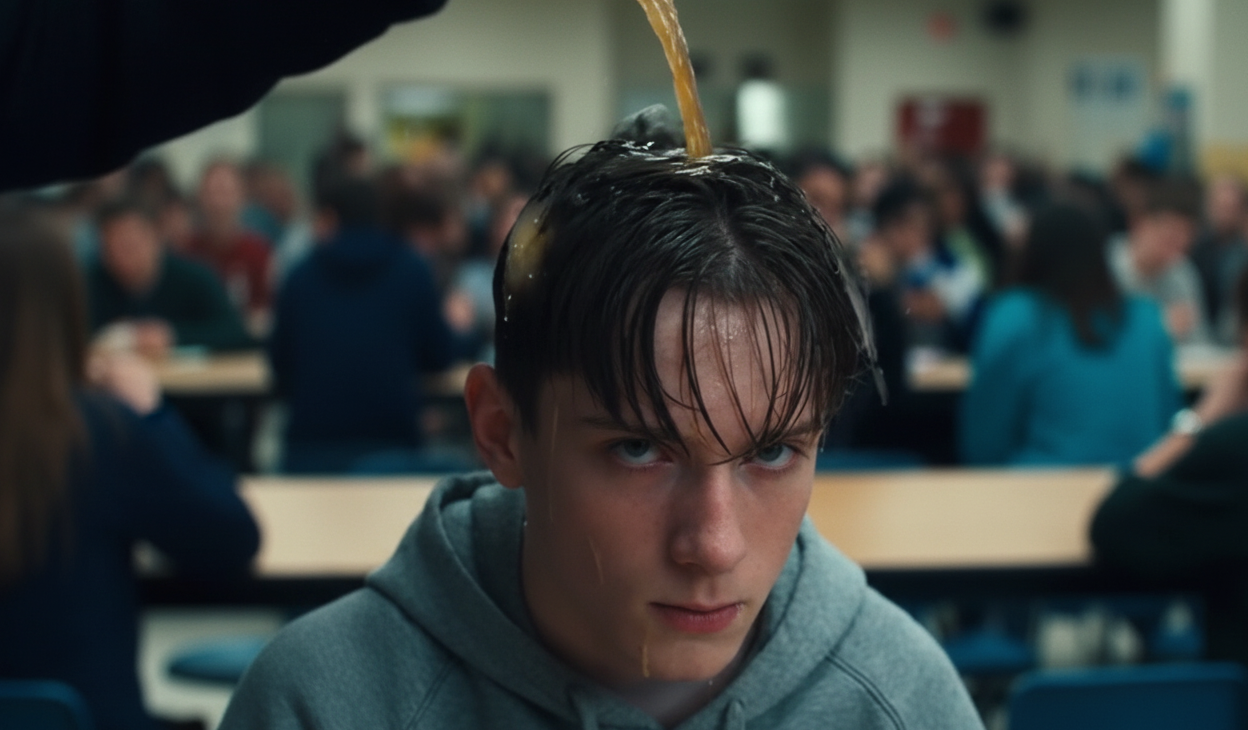
The new kid let the school bully dump coffee on his head without fighting back… But the hidden cameras captured what ended the reign of terror
I walked through the doors of Oakridge High on a Tuesday morning, backpack slung over one shoulder, already tagged with a nickname I didn’t choose.
“Fresh Meat.”
They whispered it in the hallways. Laughed it at lunch tables. I was the new transfer, the quiet one, the easy target.
My name is Jacob Daniels. Fifteen years old. Fifteen years of Taekwondo training under Master Chen. But nobody here knew that. And I intended to keep it that way.
“Your power is not for proving yourself,” Master Chen told me the night before my first day. “It’s for protecting those who cannot.”
I nodded. I understood.
What I didn’t understand yet was how much I’d need that lesson.
The hallways of Oakridge operated on a simple hierarchy: predators and prey. At the top sat Martin Pike—six feet tall, linebacker build, lawyer father, and zero consequences for anything he did.
I saw his first victim during second period.
A skinny kid named Rowan stood at his locker, hands shaking as he fumbled with the combination. Martin walked past and slammed the locker door shut—nearly catching Rowan’s fingers.
“Watch it, Rowan,” Martin said, grinning.
Rowan said nothing. Just reopened the locker with his head down.
I kept walking. Not my fight. Not yet.
Third period, Martin found me.
I was pulling my chemistry textbook from my locker when something hard shoved into my shoulder. My books scattered across the floor.
Laughter erupted around me.
Martin stood there, smirking. “Oops. My bad, Fresh Meat.”
His crew—five guys who looked like they bench-pressed smaller students for fun—circled behind him.
I bent down slowly. Picked up each book. Stacked them carefully.
“Hey, I’m talking to you,” Martin said.
I stood, met his eyes, said nothing.
“What, you deaf?”
“No,” I said quietly. “Just not interested.”
His face darkened. “You think you’re tough?”
“I think you should move.”
The hallway went silent.
Martin stepped closer. “Or what?”
I didn’t blink. “Or we’ll both be late to class.”
Someone laughed nervously. Martin’s jaw clenched. But he stepped aside.
I walked past him without looking back.
Behind me, I heard one of his crew whisper: “Dude, you just gonna let him—”
“Shut up,” Martin snapped.
Lunch was when I met Rowan properly.
He sat alone at a corner table, picking at a sandwich he clearly wasn’t eating. I took the seat across from him.
He looked up, startled. “You shouldn’t sit here.”
“Why not?”
“Because Martin… he’ll think we’re friends. And then he’ll come after you worse.”
“He’s already coming after me.”
Rowan shook his head. “You don’t get it. He doesn’t stop. Ever. Last year, a kid named Derek stood up to him. Martin broke his nose in the parking lot. Derek’s parents tried to press charges, but Martin’s dad is some hotshot attorney. It all went away.”
“Nothing goes away forever,” I said.
“You sound like you’ve never been bullied before.”
I looked at him. “I have. That’s why I know it ends when someone makes it end.”
Rowan stared at me like I’d just spoken a foreign language.
Then Martin’s shadow fell across our table.
He stood there holding a large iced coffee. Caramel swirl. Extra ice.
“Fresh Meat,” he said cheerfully. “You look hot. Let me help.”
He tipped the cup.
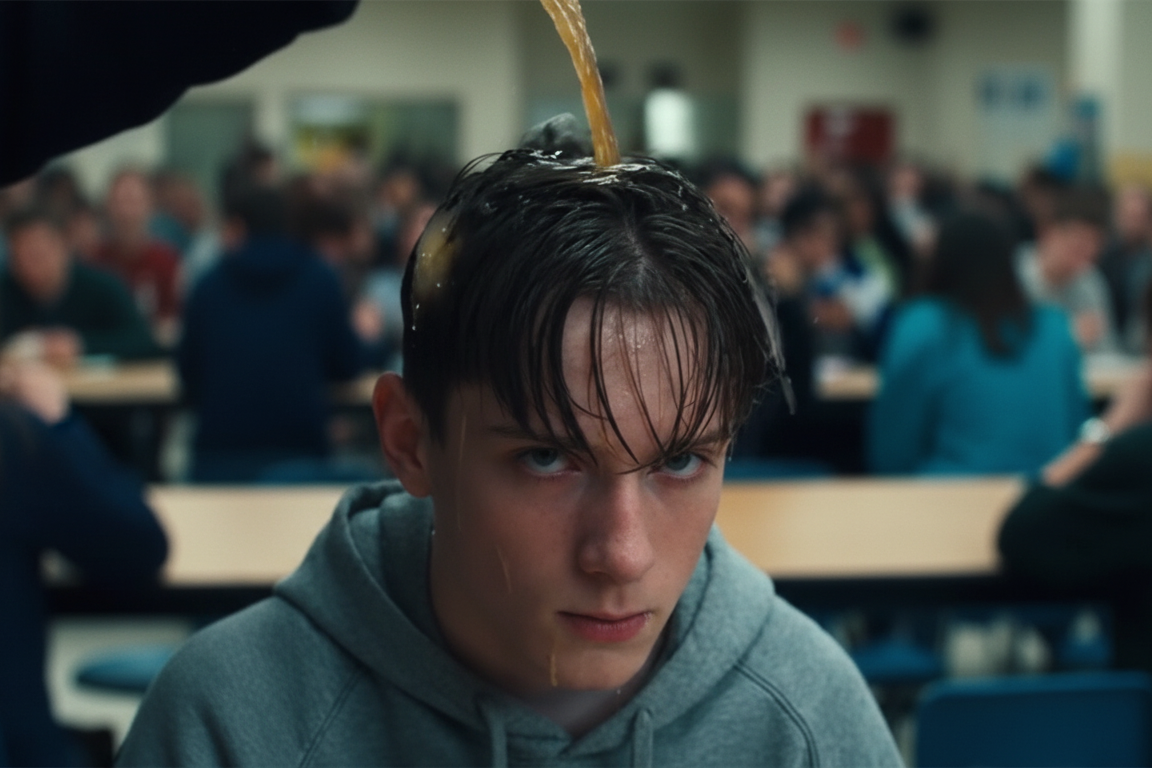
Cold coffee splashed over my head. Down my neck. Soaked my hoodie.
The cafeteria exploded with laughter and jeers. Phones came out instantly, recording.
I sat perfectly still. Let it drip. Didn’t wipe my face.
Martin leaned down. “What, gonna cry?”
I looked up at him, coffee dripping from my hair. “Are you done?”
The laughter faltered.
“What?” Martin said.
I stood slowly, eye-level with him now. “I asked if you’re done.”
His face twisted. “Sit down before I—”
“Before you what?” I said calmly. “Pour another coffee? Shove me again? Get your friends to jump me after school?”
The cafeteria had gone dead quiet.
Martin’s hand twitched toward my chest. I didn’t move.
“That’s what I thought,” he muttered. But his voice had lost its edge.
I turned and walked out of the cafeteria, soaked and silent.
Behind me, Rowan called out, “Jacob, wait—”
But I kept walking.
The video went viral by sixth period.
#CoffeeKid was trending on every platform. Students I’d never met clapped me on the shoulder. Whispered that I had guts. Asked if I was okay.
I didn’t care about the video.
But Martin did.
The next morning, Principal Hayes called us both to her office.
She played the cafeteria video on her desktop. Martin sat beside me, slouched, arms crossed.
“Mr. Pike,” she said. “Do you want to explain this?”
“It was just a joke,” Martin said. “He knows I was messing around.”
“Does this look like a joke to you?” She replayed the part where coffee drenched my head.
Martin shrugged. “He didn’t even react. So obviously he wasn’t hurt.”
Principal Hayes turned to me. “Jacob, do you have anything to say?”
I looked at Martin. Then at her. “He’s been targeting students for years. Rowan, Derek, probably a dozen others. This isn’t about coffee. It’s about power. And nobody stops him because his father makes problems disappear.”
Martin sat up straight. “That’s a lie.”
“Is it?” I pulled out my phone. Opened a folder I’d been building since day one. Photos of Rowan’s bruised arm from last week. Screenshots of group chats where Martin bragged about making kids cry. Testimonies from three students too afraid to speak up before.
I handed the phone to Principal Hayes.
Her face went pale as she scrolled.
“This ends now,” she said. “Martin, you’re suspended for one week. Mandatory counseling. And if I hear about one more incident—even a rumor—you’re expelled. Do you understand?”
Martin’s face turned red. “My dad will—”
“Your father can call me,” she said coldly. “I’ll be happy to discuss this evidence with him.”
Outside her office, Martin grabbed my arm.
“You think you’re smart?” he hissed. “Gym. After school. Three o’clock. Let’s settle this like men.”
I pulled my arm free. “I’m not interested in your games.”
“Then you’re a coward.”
“Call it whatever helps you sleep,” I said, and walked away.
But I knew he wouldn’t let it go.
At 3:15, I walked into the gym.
Half the school was there. Phones out. Bleachers packed.
Martin stood in the center with five of his crew. All of them grinning.
“Knew you’d show,” Martin said. “Can’t back down now, Fresh Meat.”
I stopped ten feet away. “This doesn’t have to happen.”
“Oh, it’s happening.”
One of his crew stepped forward. Then another. They were flanking me.
This wasn’t a fair fight. It was an ambush.
Then the gym doors slammed open.
Coach Martinez stormed in with two security guards. “Everyone out! NOW!”
The crowd scattered like roaches. Martin’s crew backed off.
Coach pointed at both of us. “My office. Now.”
But Martin didn’t move.
He lunged at me instead.
Instinct took over. Fifteen years of training compressed into two seconds.
I sidestepped. Redirected his momentum. Swept his leg.
He hit the floor hard, gasping.
The security guards grabbed him before he could get up.
Coach Martinez stared at me. “What was that?”
“Taekwondo,” I said quietly. “I didn’t want to use it.”
“Clearly,” he muttered. He turned to security. “Take Pike to the principal. Get his parents on the phone.”
This time, there was no lawyer who could twist the truth.
The gym had cameras. They caught everything—Martin’s ambush, his crew circling me, the lunge, my defensive move.
He was suspended for two weeks. Ordered into anger management. Required to issue a formal written apology to me and Rowan.
When he came back, something had shifted.
He walked the hallways differently. Quieter. No crew trailing him. No smirks.
Kids who used to scatter when he approached now just… walked past him.
Rowan started eating lunch with other people. Started laughing again.
A week later, Coach Martinez found me after class.
“Jacob, I want to start a self-defense club. Teach kids what you know. Interested?”
I thought about Rowan. About Derek. About all the others who spent years afraid.
“Yeah,” I said. “I’m in.”
The club started with eight students.
By the second week, we had twenty.
By the end of the month, thirty-five.
They didn’t come to learn how to fight. They came to learn how not to be afraid.
I taught them balance. Breathing. Awareness. The same lessons Master Chen taught me.
“You don’t need to throw a punch to be powerful,” I told them during our first session. “You just need to stand your ground.”
Rowan was there. Front row. Focused.
After class, he approached me. “Thank you.”
“For what?”
“For showing me I didn’t have to live like that anymore.”
Three months later, Martin’s parents transferred him to a private military academy upstate.
I didn’t celebrate. Didn’t gloat.
I just hoped he’d find whatever he needed to become better.
The club kept growing. Forty students. Fifty. Kids who once walked the hallways with their heads down now made eye contact. Spoke up in class. Defended each other.
Oakridge wasn’t perfect. But it was changing.
Two years later, at graduation, I sat in the auditorium watching our former club member—a freshman named Sophie who used to flinch at loud noises—give the valedictorian speech.
“Courage isn’t the absence of fear,” she said. “It’s deciding fear doesn’t get to control you anymore.”
Master Chen sat beside me, beaming.
“You did well, Jacob,” he whispered. “You used your strength to give others theirs.”
I watched Rowan laughing with his friends in the third row. Watched Sophie stand tall at the podium. Watched a school that once felt like a battlefield transform into something safer.
And I realized: Master Chen was right.
True power isn’t about winning fights.
It’s about making sure fewer fights need to happen at all.