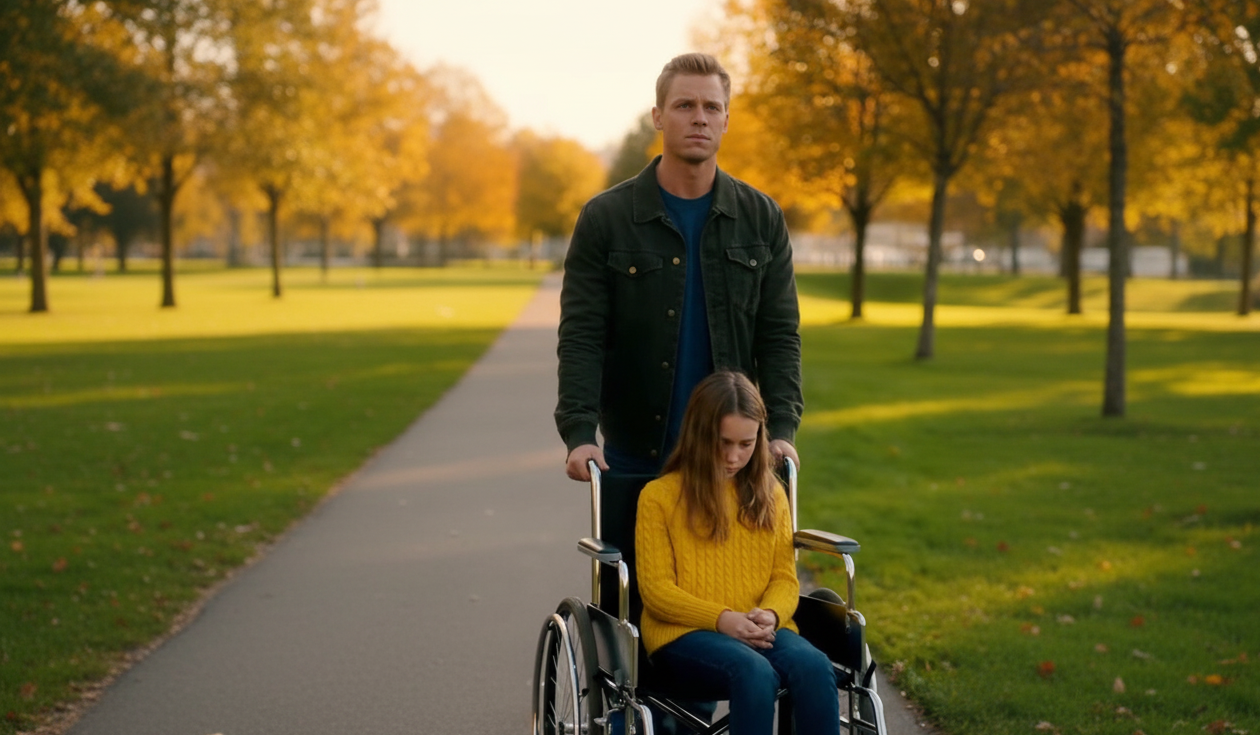
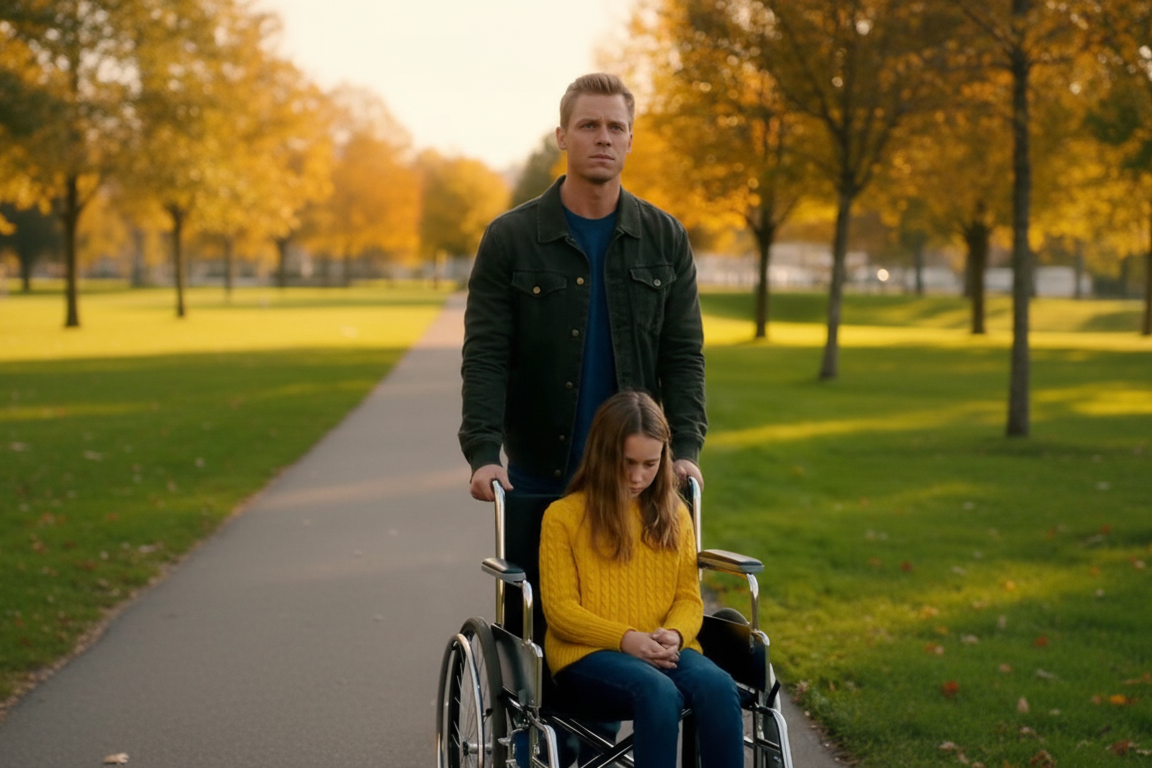
Lily hadn’t walked in three years.
The doctors called it an incomplete spinal injury. Mark called it the end of everything normal.
They sat at their usual spot in downtown Phoenix, Sunday afternoon, same park bench, same routine. Lily watched kids run past, her hands gripping the wheelchair armrests.
That’s when the boy appeared.
Torn clothes. Dirty face. Maybe ten years old.
He crossed the street slowly, staring at Lily.
“We don’t have money,” Mark said immediately.
The boy shook his head. “I don’t want money.”
“Then go.”
“I can help her walk.”
The words hit like glass breaking.
Lily’s eyes filled with tears instantly. Mark felt rage flood his chest.
“Get away from us,” Mark snapped.
The boy didn’t move. “I’ve done it before.”
“Bullshit,” Mark said. “Doctors couldn’t fix her. Specialists. Surgeons. Millions of dollars.”
“I’m not a doctor.”
“Then what are you?”
The boy pulled out a worn photograph. Two images taped together—a girl in a wheelchair, then the same girl standing.
“My sister,” he said quietly.
Lily reached for the photo with shaking hands.
Mark wanted to throw it back. “Pictures prove nothing.”
“I know,” the boy said. “That’s why I’m not asking you to believe me. I’m asking for five minutes.”
“Dad, please,” Lily whispered.
Mark looked at his daughter’s face. That careful hope. The kind that had been broken before.
“Five minutes,” Mark said. “That’s it.”
They moved to a quiet patch of grass.
“What’s your name?” Mark asked.
“Eli.”
“Tell me exactly what you’re doing.”
Eli crouched in front of Lily, keeping distance. “I’m not touching her. Not without permission.”
He picked up a small stone and pressed it gently against her shoe.
“Can you feel that?” he asked.
Lily frowned. “Barely.”
“That’s okay. That means the message still gets through.”
Mark scoffed. “Doctors said the same thing.”
Eli looked up at him. “Then they were right. The connection isn’t broken. It’s just sleeping.”
He turned back to Lily. “Close your eyes. Don’t think about walking. Just think about your feet.”
Lily closed her eyes.
Eli’s voice dropped to barely a whisper. “Your legs didn’t forget you. They’re just scared.”
“This is ridiculous,” Mark muttered.
“Then stop me,” Eli said calmly.
Mark didn’t move.
Lily’s breathing changed. Slower. Deeper.
“I feel warm,” she whispered. “My legs feel… heavy.”
Mark’s heart hammered. “Lily?”
“Heavy means awake,” Eli said. His forehead was sweating now.
“Try to move your toes,” Eli said. “Just one.”
Lily’s face tightened in concentration.
Nothing.
“That’s enough,” Mark said.
“Wait,” Lily whispered. “I think… I think one moved.”
Mark stared at her feet. They were still.
“I felt it,” she insisted.
Eli smiled faintly. “That’s how it starts.”
He leaned back, breathing hard. “That’s all for today.”
“What happened to your sister?” Mark demanded.
Eli’s face darkened. “People didn’t let her finish.”
“What does that mean?”
“It means belief scares people.”
Lily grabbed her father’s hand. “Please don’t send him away.”
Mark looked between them. Every instinct screamed to run.
“Where do you sleep?” Mark asked.
“Anywhere.”
Mark swallowed. “Be here tomorrow. Same time.”
Eli’s eyes widened. “You mean it?”
Mark nodded once.
That night, Mark didn’t sleep. He kept seeing Lily’s toes twitch. Kept wondering if he’d imagined it.
The next day, they returned to the park.
Eli was already waiting.
They repeated the routine. This time, Mark saw it clearly.
Lily’s toes moved.
Not imagination. Real movement.
“Oh my God,” Mark whispered.
Eli swayed, catching himself. His face was pale, sweat dripping.
“Eli?” Lily asked, frightened.
“I’m okay,” he said, though he clearly wasn’t.
A woman nearby whispered, “Did you see that?”
A man pulled out his phone.
Mark’s instincts flared. “Time to go.”
On the third day, everything changed.
A police cruiser sat by the curb. Two officers. A small crowd.
Mark’s stomach dropped.
“What’s going on?” he asked an officer.
“Reports of a child performing medical procedures,” the officer said. “That him?”
He pointed at Eli, who stood near the trees looking terrified.
“He’s not performing procedures,” Mark said quickly. “He’s just… talking to her.”
“That’s not appropriate, sir.”
A woman from the crowd stepped forward. Carol Henderson, fifty-three, neighborhood watch coordinator.
“That boy is clearly homeless,” she said loudly. “He’s been harassing families for days.”
“He hasn’t harassed anyone,” Mark snapped.
“He’s claiming he can cure paralysis,” Carol continued. “That’s fraud. That’s abuse.”
“He’s helping my daughter!”
Carol’s eyes narrowed. “By giving her false hope? That’s cruel.”
Lily’s voice cut through. “He’s not lying.”
Everyone turned.
“I can move my toes,” Lily said. “I couldn’t before. Now I can.”
Carol laughed. “Psychosomatic. Placebo effect.”
“You don’t know anything about my daughter,” Mark said.
“I know exploitation when I see it,” Carol shot back.
The officer stepped between them. “Ma’am, sir, please.”
Eli tried to back away.
“Don’t move,” the second officer said.
Eli’s breathing grew shallow. Panicked.
“Where are your parents?” the first officer asked.
Eli didn’t answer.
“Son, we need to take you to child services.”
“If he stops now, she won’t finish,” Eli said desperately.
Mark stepped forward. “Finish what?”
“Waking up.”
Before anyone could react, Eli collapsed.
“Eli!” Lily screamed.
Mark caught him as he fell. His body was burning up.
“Call an ambulance!” Mark shouted.
“This is what happens,” Carol said to the crowd. “When you let these people prey on the vulnerable.”
Mark rounded on her, Eli limp in his arms. “Shut your mouth.”
The ambulance arrived in minutes.
At the hospital, Mark paced while Lily was examined and Eli was rushed to emergency.
A doctor approached after an hour.
“Your daughter shows significant improvement,” she said, confusion clear in her voice. “She has voluntary motor function that wasn’t present in her previous scans.”
Mark felt dizzy. “And the boy?”
The doctor’s expression shifted. “He’s severely malnourished. Dehydrated. His body is shutting down.”
“What does that mean?”
“It means he’s been sacrificing everything to survive. Whatever he was doing with your daughter… it was costing him.”
Mark’s blood ran cold.
“Can you save him?”
“We’re trying.”
Mark sat beside Lily’s bed. She was wiggling her toes, tears streaming down her face.
“Is Eli okay?” she whispered.
“They’re working on him.”
“Dad… I can feel my legs. Really feel them.”
Mark took her hand. “I know, sweetheart.”
“Why didn’t Eli tell us he was sick?”
Mark’s throat tightened. “Because he cared more about you than himself.”
A nurse entered at dawn. Her face said everything.
“The boy?” Mark asked.
She shook her head. “I’m sorry. His heart gave out.”
Lily sobbed into her father’s chest.
Two weeks later, Mark sat in the hospital administrator’s office.
“We need to discuss the incident,” the administrator said.
“What incident?”
“The boy. The complaints. Mrs. Henderson has filed a formal grievance claiming your family endangered a minor.”
Mark’s jaw tightened. “Eli saved my daughter’s life.”
“That’s not the narrative being presented.”
“Then let me present the truth.”
Mark stood and walked to the window. Below, in the therapy courtyard, Lily stood between parallel bars, taking careful steps.
“My daughter is walking,” Mark said. “For the first time in three years.”
“That’s wonderful, but—”
“No buts,” Mark interrupted. “Eli died because he gave everything to help her. And Carol Henderson wants to make him a villain because she doesn’t understand what she saw.”
The administrator sighed. “What do you want, Mr. Wilson?”
“A memorial,” Mark said. “In Eli’s name. For homeless children. Real help, not bureaucracy.”
“That’s… unusual.”
“So was Eli.”
Three months later, the memorial opened. A small clinic downtown offering free medical care and shelter to homeless youth.
Carol Henderson led a protest outside on opening day.
“This glorifies fraud!” she shouted. “That boy wasn’t a healer, he was a con artist!”
Mark stood on the clinic steps with Lily beside him. She stood on her own, no wheelchair, just a cane for balance.
The news cameras turned.
“Eli taught my daughter to believe in herself,” Mark said clearly. “He asked for nothing. No money. No recognition. Just a chance to help.”
“He died!” Carol yelled. “That’s proof it was fake!”
“He died,” Mark agreed, “because he gave everything. Including his life.”
The crowd shifted. Murmurs of discomfort.
A reporter stepped forward. “Mr. Wilson, do you believe the boy had supernatural abilities?”
“I believe,” Mark said carefully, “that Eli saw something doctors didn’t. Whether that was skill, instinct, or something else doesn’t matter. What matters is my daughter walks because he cared.”
Lily stepped forward, speaking into the microphone without help.
“Eli was ten years old,” she said. “He was alone. He was scared. And he still chose to help me when everyone else had given up.”
Her voice didn’t waver.
“If you want to protest something, protest the system that failed him. Protest the people who walked past him every day. Don’t protest his memory.”
The cameras flashed.
Carol’s face flushed. She looked around at the shifting crowd, then turned and walked away.
The clinic doors opened.
Five children entered that first day. Lost. Hungry. Alone.
By the end of the month, twenty-three.
Mark stood in his daughter’s room that night, watching her practice her steps.
“Does it still hurt?” he asked.
“Every day,” Lily said. “But that’s okay.”
“Why?”
She turned to him, eyes bright. “Because Eli made me promise something before he left.”
“What?”
“To keep going. No matter what.”
Mark felt his eyes burn.
In his pocket was the photograph. Eli’s sister. Standing.
He’d never found out if the photo was real.
It didn’t matter anymore.
What mattered was Lily was standing.
And Eli’s memory would never be forgotten.
Six months later, Carol Henderson’s son was arrested for embezzling from the neighborhood watch fund.
The irony wasn’t lost on anyone.
The clinic thrived. Dozens of children found help. Found hope.
Found what Eli had given Lily.
A chance.
One year after Eli’s death, Lily walked into the clinic without her cane.
The staff erupted in applause.
Mark stood at the back, tears streaming.
Some people are forgotten by the world.
But not by the ones they save.
Not ever.